Laryngeal tuberculosis: a case report

Agnė Pašvenskaitė1, Deimantė Bajoriūnaitė2, Roberta Buginytė2, Virgilijus Ulozas1

1 Lithuanian University of Health Sciences, Department of Otorhinolaryngology, Kaunas, Lithuania

2Lithuanian University of Health Sciences, Academy of Medicine, Kaunas, Lithuania

Abstract

Background. Laryngeal tuberculosis is a rare form of tuberculosis that usually develops due to direct spread from a bronchus or hematogenous spread. The most common symptom related to laryngeal tuberculosis is hoarseness which also can be led by dysphagia, odynophagia, cough, or nonspecific symptoms like fever or localized pain. To confirm laryngeal tuberculosis, histopathologic examination is necessary because it can mimic laryngeal cancer. Diagnosis of laryngeal tuberculosis is made through a combination of a comprehensive otorhinolaryngological examination, imaging, laboratory and histological analysis.

Case report. We describe the case of a 62-year-old Lithuanian man who presented with the clinical picture of laryngeal cancer, but which turned out to be tuberculosis. We illustrate the difficulty of recognizing laryngeal tuberculosis both clinically and even with radiological examination.

Discussion. Laryngeal tuberculosis is a rare condition that can mimic laryngeal cancer. In male patients with a history of smoking and complaining of dysphonia, odynophagia, and cough LT is a diagnosis to be considered.

Keywords: Laryngeal tuberculosis, tuberculosis, dysphagia, odynophagia, cough.

Full article

Journal of Medical Sciences. May 3, 2021 - Volume 9 | Issue 4. Electronic - ISSN: 2345-0592
175
Medical Sciences 2021 Vol. 9 (4), p. 175-180
Laryngeal tuberculosis: a case report
Agnė Pašvenskaitė
1
, Deimantė Bajoriūnaitė
2
, Roberta Buginy
2
, Virgilijus Ulozas
1
1
Lithuanian University of Health Sciences, Department of Otorhinolaryngology, Kaunas, Lithuania
2
Lithuanian University of Health Sciences, Academy of Medicine, Kaunas, Lithuania
Abstract
Background. Laryngeal tuberculosis is a rare form of tuberculosis that usually develops due to direct spread from a
bronchus or hematogenous spread. The most common symptom related to laryngeal tuberculosis is hoarseness
which also can be led by dysphagia, odynophagia, cough, or nonspecific symptoms like fever or localized pain. To
confirm laryngeal tuberculosis, histopathologic examination is necessary because it can mimic laryngeal cancer.
Diagnosis of laryngeal tuberculosis is made through a combination of a comprehensive otorhinolaryngological
examination, imaging, laboratory and histological analysis.
Case report. We describe the case of a 62-year-old Lithuanian man who presented with the clinical picture of
laryngeal cancer, but which turned out to be tuberculosis. We illustrate the difficulty of recognizing laryngeal
tuberculosis both clinically and even with radiological examination.
Discussion. Laryngeal tuberculosis is a rare condition that can mimic laryngeal cancer. In male patients with a
history of smoking and complaining of dysphonia, odynophagia, and cough LT is a diagnosis to be considered.
Keywords: Laryngeal tuberculosis, tuberculosis, dysphagia, odynophagia, cough.
Journal of Medical Sciences. May 3, 2021 - Volume 9 | Issue 4. Electronic - ISSN: 2345-0592
176
1. Introduction
Tuberculosis (TB) is a chronic bacterial infection
induced by a bacterial species belonging to the
Mycobacterium tuberculosis complex. Laryngeal
tuberculosis (LT) is a rare disease, with an incidence
of less than 1% [1,2]. The disease usually results
from pulmonary tuberculosis due to direct spread
from contaminated sputum, although it might be
localized in the larynx as a primary lesion without
any pulmonary involvement [3-5]. Delays in
diagnosing LT could be explained by seemingly
irrelevant symptoms such as hoarseness as only
severe symptoms of later stages (laryngeal stenosis
with dyspnoea and stridor, dysphagia, otalgia,
odynophagia, and haemoptysis) lead these patients to
doctor’s consultation [6]. Endoscopic laryngeal
examination (video laryngostroboscopy, flexible
endoscopy, contact endoscopy) performed by an
otorhinolaryngologist is the first diagnostic tool in LT
suspicion. Besides, laryngoscopic alterations in a
case of LT can often mimic laryngeal cancer [7,8].
Direct laryngoscopy with a biopsy is mandatory to
establish a definitive diagnosis. Diagnosis of LT is
confirmed by identification of a caseating granuloma
in a biopsy specimen [9,10]. This report presents a
case of LT in a patient with primary pulmonary
tuberculosis.
2. Case report
Patient’s anamnesis. A 62-year-old male presented
at the Outpatient Office of the Department of
Otorhinolaryngology, Hospital of Lithuanian
University of Health Sciences, Kaunas Klinikos in
September 2020. The patient was complaining of
difficulty in swallowing and a slight loss of weight
for over 3 months. The patient was previously treated
for fungal laryngeal infection and also tested for TB,
but the diagnosis was rejected. Social and
occupational history was significant for working in a
dusty environment and smoking for many years.
Otorhinolaryngological examination. A
comprehensive otorhinolaryngological examination
including video laryngostroboscopy and neck
palpation was carried out. During laryngeal
inspection, necrotic masses were observed on the
laryngeal surface of the epiglottis. Vocal folds were
mobile and intact. Initial laboratory examinations
revealed slightly elevated C-Reactive Protein,
microcytic microchromic anemia.
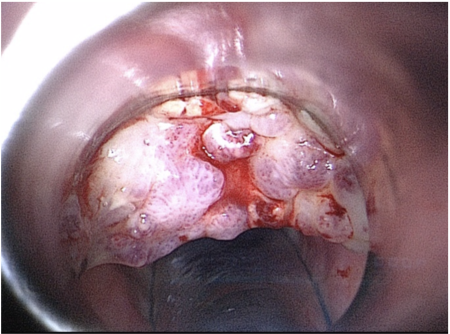
Treatment strategy. In suspicion of possible
epiglottic tumor, direct microlaryngoscopy was
performed and multiple biopsy samples were taken
on the 3
rd
of September, 2020 (Figure 1). No specific
alterations in piriform sinuses, aryepiglottic folds,
valleculas, ventricles or vocal folds were identified.
Biopsy results (No. H1377-20 07/09/2020) revealed
some necrotic granuloma-like structures with solitary
Langhans giant cells and no tumourous changes with
the suggestion of LT.
Additional examination:
Chest X-ray (07/09/2020): multiple small
merging focal infiltration in the middle lobe and
basal parts of the right lung.
Conclusion: more detailed examination is
required (Chest-Thorax CT scan).
Contrast-enhanced chest CT (09/09/2020):
groups of small clustered micro focuses which
partially form a tree-in-bud sign. In the
background of right lung L1 and S6 observable
solitary 0.8-1.1 cm size focus (Figure 2).
Neck-Larynx CT with i/v contrast
(09/09/2020): free part of epiglottis unevenly
Journal of Medical Sciences. May 3, 2021 - Volume 9 | Issue 4. Electronic - ISSN: 2345-0592
177
thickened, inferior epiglottic contour uneven,
observable epiphytical growing masses with a
non-intensive accumulation of contrast (Figure
3). A suspicious lymph node in the VI group of
neck lymph nodes was observed. Observable
lungs' upperparts are with clusters of small
focuses.
Conclusion: alterations in epiglottis are
non-specific. Evaluating epiglottic and
pulmonary alterations does not deny a
diagnosis of tuberculosis, but it should be
differentiated with hypervascular tumor.
Fibrobronchoscopy (09/09/2020): bronchial
mucosa is slightly hyperemic, edematous, with a
small amount of unclear mucus on both sides.
Bronchial sputum was collected for
histopathological analysis.
Multidisciplinary team meeting (09/09/2020)
composed of otorhinolaryngologist,
pulmonologist, pathologist conclusion: for
further treatment of TB the patient should be
treated in a tuberculosis hospital with a
recommendation of otorhinolaryngological
examination after the treatment of TB.
Figure 1. Direct microlaryngoscopy: necrotic masses on the laryngeal surface of epiglottis.
Journal of Medical Sciences. May 3, 2021 - Volume 9 | Issue 4. Electronic - ISSN: 2345-0592
178
Figure 2. Contrast Chest CT with multiple pulmonary foci
Figure 3. Contrast Neck-Larynx CT: red arrows indicate epiphytical growing masses of the epiglottis.
Journal of Medical Sciences. May 3, 2021 - Volume 9 | Issue 4. Electronic - ISSN: 2345-0592
179
3. Discussion
LT is the most common granulomatous laryngeal
disease [11]. In most cases, it can be simply
misdiagnosed due to no pathognomonic or little
worrying symptoms such as hoarseness [12]. The
attention should be focused on men aged 40-60 with
risk factors like HIV, diabetes, immunosuppressive
drug use, and a history of smoking [13,14]. Also,
endoscopic tests demonstrate more destructive
alterations in smokers than in non-smokers, leading
to the hypothesis that smoke results in a chronic
effect on the laryngeal mucous membrane [15].
LT mostly affects epiglottis, vocal and vestibular
folds. However, it can spread to any part of the
larynx. [16]. Symptoms are associated with affected
sites, manifesting in dysphonia, odynophagia and
weight loss, dyspnea on exertion, and cough [17].
Diagnosis of LT is made through a combination of a
comprehensive otorhinolaryngological examination,
imaging, laboratory, and histological analysis [18].
The gold standard for confirming TB is
mycobacterium tuberculosis culture, but the growth
cycle is long and may delay the treatment. Another
method that is quick and simple is acid-fast staining,
but it has a low positive rate. Moreover, in LT cases
smear and culture might be ineffective due to low
concentrations of bacilli in the larynx [19]. The
larynx is a secondary location for TB infection [16].
For this reason, the first recommended step in
diagnosing TB is Chest X-ray or/and Chest CT to
assess the pulmonary involvement [16]. Another
challenge in diagnosing LT is its inconsistent lesion
presentation in the laryngoscopic examination LT
can mimic other diseases such as laryngeal form of
gastroesophageal reflux disease, leukoplakia, contact
ulcer, polyp, or malignancy [20]. To understand
better the spread of the disease CT scan and/or MR
imaging is recommended. Signs of laryngeal TB in
CT include focal thickening or mass in the epiglottis,
vocal folds, and paralaryngeal tissues [7].
Histopathological analysis might show granulomas
with giant cells with or without necrosis, tuberculosis
mycobacterium, positive results of acid-fast stain
[19].
A well-known drug-susceptible TB treatment
includes a 6-month course of isoniazid (INH),
rifampin (RIF), pyrazinamide (PZA), and ethambutol
(EMB), when all four drugs are used for 2 months,
with the continuation of INH and RIF for 4 more
months. In cases where initiation of treatment is
delayed the course could be extended up to 9 months.
In cases of rifampicin-resistant or multidrug-resistant
tuberculosis, it is recommended to use second-line
drug combinations, and the treatment regimen is
increased to at least 18-months [18].
To conclude, LT is a rare condition that can often
mimic laryngeal cancer. In male patients with a
history of smoking and complaining of dysphonia,
odynophagia, and cough LT is a diagnosis to be
considered.
References
1.Matsuura H, Yamaji Y. Laryngeal tuberculosis: a
forgotten disease. QJM. 2017;110(8):521.
doi:10.1093/qjmed/hcx078
2. Harney M, Hone S, Timon C, et al. Laryngeal
tuberculosis: important diagnosis. J Laryngol Otol
2000; 114: 87880
3.E Özüdogru, H Çakli, EE Altuntas,1 and MK
Gürbüz. Effects of laryngeal tuberculosis on vocal
fold functions: case report. Acta Otorhinolaryngol
Ital. 2005 Dec; 25(6): 374377.
Journal of Medical Sciences. May 3, 2021 - Volume 9 | Issue 4. Electronic - ISSN: 2345-0592
180
4. Lim JY, Kim KM, Choi EC, Kim YH, Kim HS, et
al. (2006) Current clinical propensity of laryngeal
tuberculosis: review of 60 cases. Eur Arch
Otorhinolaryngol 263: 838-842.
5. Nalini B, Vinayak S: Tuberculosis in ear, nose, and
throat practice: its presentation and diagnosis. Am J
Otolaryngol. 2006, 27: 39-45.
10.1016/j.amjoto.2005.07.005.
6. Lazarus AA, Thilagar B: Tuberculosis of
pericardium, larynx, and other uncommon sites, Dis
Mon 53:4654, 2007
7. Cengiz A, Göksel S, Başal Y, Taş Gülen Ş, Döğer
F, Yürekli Y. Laryngeal Tuberculosis Mimicking
Laryngeal Carcinoma on 18F-FDG PET/CT Imaging.
18F-FDG PET/BT Görüntülemede Maligniteyi Taklit
Eden Laringeal Tüberküloz. Mol Imaging Radionucl
Ther. 2018;27(2):81-83. doi:10.4274/mirt.44366
8. Lim JY, Kim KM, Choi EC, Kim YH, Kim HS,
Choi HS: Current clinical propensity of laryngeal
tuberculosis: review of 60 cases. Eur Arch
Otorhinolaryngol. 2006, 263: 838-842.
10.1007/s00405-006-0063-5.
9. Kiakojuri K, Hasanjani Roushan MR. Laryngeal
tuberculosis without pulmonary involvement.
Caspian J Intern Med. 2012;3(1):397-399.
10. Jeana L. Benwill, Juan C. Sarria, Laryngeal
tuberculosis in the United States of America: A
forgotten disease. Scandinavian Journal of Infectious
Diseases, 2014; 46: 241249
11.Cole AE, Heaton D, Chekairi A. Laryngeal
tuberculosis: a rare cause of critical airway
obstruction. BMJ Case Rep.
2018;2018:bcr2017222841. Published 2018 Jan 17.
doi:10.1136/bcr-2017-222841
12.Paulauskienė I, Mickevičienė V. Dysphonia - the
single symptom of rifampicin resistant laryngeal
tuberculosis. Open Med (Wars). 2016;11(1):63-67.
Published 2016 Mar 26. doi:10.1515/med-2016-0013
13. Jindal SK, Jindal A, Agarwal R. Upper
Respiratory Tract Tuberculosis. Microbiol Spectr.
2016;4(6):10.1128/microbiolspec.TNMI7-0009-
2016. doi:10.1128/microbiolspec.TNMI7-0009-2016
14. Corbett EL, Watt CJ, Walker N, Maher D,
Williams BG, Raviglione MC et al. The growing
burden of tuberculosis: global trends and interactions
with the HIV epidemic. Arch Intern Med. 2003 May
12; 163(9):1009-21.
15.Kurokawa M, Nibu K, Ichimura K, Nishino H.
Laryngeal tuberculosis: A report of 17 cases. Auris
Nasus Larynx. 2015;42(4):305-310.
doi:10.1016/j.anl.2015.02.012
16. Eltilib M, Boyd W, Saramago I, Askin F, Zamora
C. Laryngeal tuberculosis mimicking malignancy: A
case report. Clin Case Rep. 2020;8(7):1209-1212.
Published 2020 Apr 21. doi:10.1002/ccr3.2882
17. Reis JGC, Reis CSM, Costa DCSd, Lucena MM,
Schubach AdO, et al. Factors Associated with
Clinical and Topographical Features of Laryngeal
Tuberculosis. 2016; PLOS ONE 11(4): e0153450.
https://doi.org/10.1371/journal.pone.0153450
18. Qian X, Albers AE, Nguyen DTM, et al. Head
and neck tuberculosis: Literature review and meta-
analysis. Tuberculosis (Edinb). 2019;116S:S78-S88.
doi:10.1016/j.tube.2019.04.014
19.Yu Z, Lu R, Gan M, Tu X, He Z. Mycobacterial
identification on homogenised biopsy facilitates the
early diagnosis and treatment of laryngeal
tuberculosis. Open Med (Wars). 2020;15(1):508-512.
Published 2020 Jun 5. doi:10.1515/med-2020-0171
20. Agarwal R, Gupta L, Singh M, et al. Primary
Laryngeal Tuberculosis: A Series of 15 Cases. Head
Neck Pathol. 2019;13(3):339-343.
doi:10.1007/s12105-018-0970-y