Eglė Bakučionytė 1, Iveta Idzelytė 2, Miglė Ivanauskaitė 2
1 Republic Hospital of Klaipeda, Klaipeda, Lithuania
2 Lithuanian University of Health Sciences, Academy of Medicine, Faculty of Medicine, Kaunas, Lithuania
ABSTRACT
Tracheal rupture is a rare iatrogenic complication of endotracheal intubation that occurs only in 1/20,000-75,000 patients. This condition requires prompt diagnosis and treatment because of high morbidity and mortality. We present a case report of a 81-year-old woman that presented with subcutaneous emphysema just after modified radical mastectomy.
Keywords: tracheal rupture, endotracheal intubation, pneumothorax, pneumomediastinum, subcutaneous emphysema.

Journal of Medical Sciences. June 30, 2020 - Volume 8 | Issue 18. Electronic - ISSN: 2345-0592
161
Medical Sciences 2020 Vol. 8 (18), p. 161-167
Tracheal rupture after endotracheal intubation: a rare case
report
Eglė Bakučionytė
1
, Iveta Idzelytė
2
, Miglė Ivanauskaitė
2
1
Republic Hospital of Klaipeda, Klaipeda, Lithuania
2
Lithuanian University of Health Sciences, Academy of Medicine, Faculty of Medicine, Kaunas, Lithuania
ABSTRACT
Tracheal rupture is a rare iatrogenic complication of endotracheal intubation that occurs only in 1/20,000-
75,000 patients. This condition requires prompt diagnosis and treatment because of high morbidity and
mortality. We present a case report of a 81-year-old woman that presented with subcutaneous emphysema just
after modified radical mastectomy.
Keywords: tracheal rupture, endotracheal intubation, pneumothorax, pneumomediastinum, subcutaneous
emphysema

Journal of Medical Sciences. June 30, 2020 - Volume 8 | Issue 18. Electronic - ISSN: 2345-0592
162
INTRODUCTION
Tracheal rupture is not a very common but life
threatening condition. It can be caused by severe
trauma or by iatrogenic causes such as
endotracheal intubation (1). Tracheal rupture is a
very rare complication of elective endotracheal
intubation with the incidence of 1/20,000-75,000
patients and a higher incidence of 15% in
emergently performed endotracheal intubations
(2, 3). This condition is associated with high
morbidity and mortality, for this reason prompt
diagnosis is vital for the survival of the patients.
However the delay of diagnosis ranges from 3 to
72 hours because the symptoms of tracheal
rupture are not specific (2, 4). Despite a lack of
specificity, the clinical signs can be highly
suggestive, so it is important to be aware of
causes, clinical manifestations, diagnosis and
treatment.
We report a clinical case of tracheal rupture after
endotracheal intubation in a patient who had
modified radical mastectomy and presented with
subcutaneous emphysema just after the surgery.
The aim of our report is to raise awareness of this
rare but life threatening complication which can
be successfully treated if clinical manifestations
and radiological signs are detected early.
CASE REPORT
A 81-year-old woman diagnosed with a left
invasive lobular carcinoma of the left breast was
hospitalized at our hospital for modified radical
mastectomy. After extubation subcutaneous
emphysema was seen in the face, neck and upper
chest. Chest radiography was perfomed – there
were signs of subcutaneous emphysema and
pneumomediastinum. Urgent computed
tomography (CT) scan with and without contrast
revealed subcutaneous emphysema, right side
pneumothorax, which wasn‘t visible in plain film,
pneumomediastinum and tracheal deformation
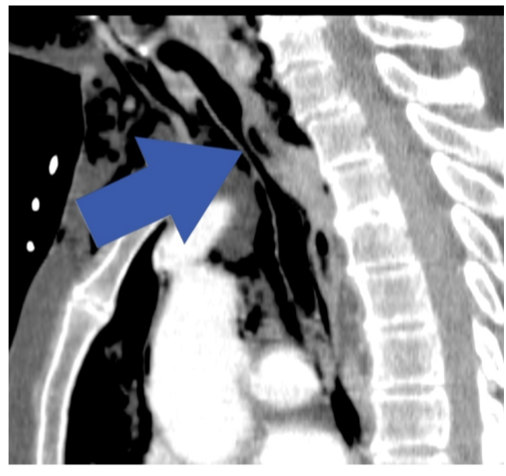
just above the manubrium of sternum level. There
was a 3 cm long defect in the posterior wall of the
trachea, esophagus wall was prolobating inside
the lumen of the trachea, the lumen was narrowed
– only 0,2 cm in width – consistent with a rupture
of the trachea (Figures – 1-3). Bronchoscopy
confirmed the defect of the membranous wall of
trachea (Figure 4) and pathological movement
while breathing. In laboratory tests – hemoglobin
level 132 g/l, white blood cell count (WBC) 7.67
10
9
/l, platelet count 217 10
9
/l, prothrombin time
12.6 seconds, international normalized radio
(INR) 1.03, creatinine 198 µmol/l, urea 18.64
mmol/l, C-reactive protein (CRB) 6 mg/l.
Electrolytes were normal.
Concerning the management, the right pleural
cavity was drained and to ensure oxygenation the
patient was intubated by a smaller size
endotracheal tube. The distal end was 1 cm above
the carina and the tracheal defect was partially
covered with the cuff. In order to provide
adequate lung ventilation, the mechanical
ventilator was used. The patient received inffusion
therapy, analgetics and antibiotic therapy.
During the hospitalization, the chest radiography
was performed every day due to better
pneumothorax and subcutaneus emphysema
control. The second day there were no signs of
pneumothorax and pneumomediastinum, pleural
drain was removed, subcutaneous emphysema
was reducing and the patient was extubated.

Journal of Medical Sciences. June 30, 2020 - Volume 8 | Issue 18. Electronic - ISSN: 2345-0592
163
Repeated laboratory tests remained normal. Due
to the improving condition the patient was
discharged from the hospital and continued
treatment at home with a general practitioner’s
supervision.
Figure 1. Contrast-enhanced CT axial view – tracheal
rupture, prolabation of esophageal wall in the lumen of
trachea.
Figure 2. Contrast-enhanced CT axial view, lung window –
prolabation of esophagus in the lumen of trachea,
narrowing of the lumen of trachea, subcutaneous
emphysema.

Journal of Medical Sciences. June 30, 2020 - Volume 8 | Issue 18. Electronic - ISSN: 2345-0592
164
DISCUSSION
Figure 3. Contrast-enhanced CT sagital view –
narrowing of tracheal lumen.
Figure 4. Bronchoscopy, endotracheal view – tracheal
rupture, prolabation of esophageal wall in the lumen of
trachea.
Journal of Medical Sciences. June 30, 2020 - Volume 8 | Issue 18. Electronic - ISSN: 2345-0592
165
There are several risk factors contributing to
tracheal rupture after endotracheal intubation
which can be divided into mechanical and
anatomical. Anatomical factors contribute to the
weakening of esophageal wall while mechanical
factors act as a traumatic force. Mechanical
factors include emergency, sudden movement of
the tube without deflating the cuff, several forced
attempts at intubation, endotracheal tube stylets
protruding beyond the tip of the tube, unsuitable
size of the tube, overinflation of the cuff,
repositioning the patient while intubated, vigorous
coughing and a lack of experience in intubation.
Anatomical factors include female gender, age
above 50 as in our case, short stature, elevated
body mass index, chronic use of corticosteroids,
congenital tracheal malformations, chronic
obstructive pulmonary disease and other
inflammatory diseases (4-7). The exact
mechanism of the tracheal laceration following
endotracheal intubation remains uncertain, our
patient had risk factors such as age and gender
predisposition. We suspect that the cause could be
overinflation of the cuff, which is thought to be
the most common cause of tracheal rupture. The
incidence of this complication has reduced since
the introduction of “high-volume-low-
pressure”cuffs although has not completely
eliminated. Relative overinflation can occur if the
cuff is inflated above carina where the trachea is
of the largest diameter and then is positioned to its
correct place (8). The laceration is usually
longitudinal and located in the posterior part of
the trachea which is not supported by
cartilaginous rings (4).
The clinical signs of tracheal disruption include
subcutaneous emphysema, pneumomediastinum,
pneumothorax, respiratory failure, dyspnea,
dysphagia, hemoptysis and pneumoperitoneum (4,
5, 7). Usually these signs appear during surgery,
immediately or as in our case soon after
extubation, though sometimes they can take
several days to develop (4, 5). Subcutaneous
emphysema is the most common sign of tracheal
rupture as well as a protective factor. Its
appearance leads to suspicion of a tracheal
disruption resulting in acceleration of diagnostic
procedures and early treatment (4).
Clinical suspicion must be followed by diagnostic
confirmation, which is achieved by radiological
investigations and bronchoscopy. Chest
radiographs show radiolucent areas in soft tissue,
that consistent with subcutaneous emphysema,
sometimes striated pattern expected from a
pectoralis major muscle which is called ginkgo
leaf sign may be seen (9). Pneumomediastinum is
a common finding that is seen as a thin vertical
line located parallel to mediastinal border (10).
Pneumothorax 40% of cases can be revealed only
by CT scan (1). In our case right pneumothorax
wasn’t seen in the plain film.
Extrapulmonary air is an indirect sign of tracheal
rupture that is seen in CT scans. The direct signs
are either discontinuity of tracheal wall, or
deformation of its length (1). CT multiplan
reconstructions are very useful for measuring the
exact length of laceration. Bronchoscopy still
remains the gold standard for the detection of
tracheal rupture because of direct visualization (4,
7). Bronchoscopy helps to detect not only the
exact location of the lesion, extension (length and
depth), but also herniation of the esophageal wall
into tracheal lumen as well as provide options of

Journal of Medical Sciences. June 30, 2020 - Volume 8 | Issue 18. Electronic - ISSN: 2345-0592
166
endoscopic or endoscopic-assisted treatment (1).
In our case the herniation was well seen in CT. It
is important to observe if subcutaneous
emphysema is increasing and to measure the
length of laceration because it determines the
therapeutic approach (1).
The treatment options depend on the location and
size of the injury, its clinical manifestations and
the condition of the patient. Conservative
treatment is selected if the patient is clinically
stable and the laceration is less than 4 cm located
in the upper part of trachea and not involving all
tracheal layers (8). Surgical treatment is preffered
with a transmural laceration larger than 2 cm and
the presence of esophageal herniation into the
tracheal lumen. The progression of subcutaneous
emphysema and pneumomediastinum, early signs
of mediastinitis and detection of the rupture
during surgery are also indications for surgical
treatment (1, 8). In our case the patient was older,
the lesion was 3cm and she was improving fast, so
conservative treatment was chosen. In every case
healing should be evaluated by tracheal
fibroendoscopy one month after the injury (6).
CONCLUSION
Tracheal rupture is a rare but life threatening
iatrogenic complication after endotracheal
intubation. Our case report is a reminder that
radiological signs have an important value
diagnosing this pathology and may help to
determine the therapeutic approach.
REFERENCES
1. Paraschiv M. Iatrogenic tracheobronchial
rupture. Journal of Medicine and Life.
2014;7(3):343–348
2. Panagiotopoulos N, Patrini D, Barnard M,
Koletsis E, Dougenis D, Lawrence D.
Conservative versus Surgical Management of
Iatrogenic Tracheal Rupture. Medical Principles
and Practice. 2017;26:218–220.
3. Eliçora A, Akgül AG, Topçu S, Özbay S,
+RúWHQ T, Sezer HF, Eliçora SS. Management
of post-intubation tracheal membrane ruptures.
Arch Iran Med. 2016; 19(7): 491 – 495.
4. Miñambres E, Burón J, Ballesteros MA, Llorca
J, Muñoz P, González-Castro A. Tracheal rupture
after endotracheal intubation: a literature
systematic review. European Journal of Cardio-
Thoracic Surgery. 2009;35:1056–1062
5. Lim H, Kim JH, Kim D, Lee J, Son JS, Kim
DC, ir kt. Tracheal rupture after endotracheal
intubation - A report of three cases -. Korean J
Anesthesiol. 2012;62(3):277–80.
6. Prunet B, Lacroix G, Asencio Y, Cathelinaud
O, Avaro J-P, Goutorbe P. Iatrogenic post-
intubation tracheal rupture treated conservatively
without intubation: a case report. Cases Journal.
2008;1.
7. Farley LS, Schlicksup KE. Tracheal Injury.
StatPearls [Internet]. Treasure Island (FL):
StatPearls Publishing; 2020 [Accessed 8 May
2020] Access:
http://www.ncbi.nlm.nih.gov/books/NBK547677/

Journal of Medical Sciences. June 30, 2020 - Volume 8 | Issue 18. Electronic - ISSN: 2345-0592
167
8. Óvári A, Just T, Dommerich S, Hingst V,
Böttcher A, Schuldt T, ir kt. Conservative
management of post-intubation tracheal tears—
report of three cases. J Thorac Dis.
2014;6(6):E85–91
9. Medeiros BJ da C, Medeiros BJ da C.
Subcutaneous emphysema, a different way to
diagnose. Revista da Associação Médica
Brasileira. 2018;64(2):159–63.
10. Marchiori E, Hochhegger B, Zanetti G.
Pneumomediastinum. J Bras Pneumol [Internet].
2019 m. [Accessed 8 May 2020];45(4). Access:
https://www.ncbi.nlm.nih.gov/pmc/articles/PMC6
733727/
11. Arshad H, Young M, Adurty R, Singh A.
Acute Pneumothorax. Critical Care Nursing
Quarterly. 2016;39(2):176–89.