Tumor-induced osteomalacia: nasal cavity phosphaturic mesenchymal tumor a case report and radiologic review

Augustinas Bielinis1, Ruta Kliokyte1, Renata Komiagiene1, Algirdas Edvardas Tamosiunas1

1 Centre of Radiology and Nuclear Medicine, Vilnius University Hospital Santara Clinics, Santariškių g. 2, Vilnius, Lithuania

Abstract

Background and aim: Phosphaturic mesenchymal tumor is a rare neoplasm composed of bone and soft tissue that is the most common cause of tumor-induced osteomalacia. Due to its nonspecific clinical presentation, rare occurrence and variable features on imaging, diagnosis is often delayed. Our aim is to review this rare disease and it’s diagnostic imaging.

Case presentation: We present a case of a 44-year-old male who presented with osteomalacia-related symptoms and was found to have a nasal cavity mass expressing somatostatin receptors.

Conclusion: Functioning imaging plays a key role in localization of this rare entity with conventional imaging such as computed tomography and magnetic resonance imaging useful in pre-surgery planning.


Keywords: phosphaturic mesenchymal tumor, tumor induced osteomalacia, octreoscan, bone scan.


Journal of Medical Sciences. Mar 18, 2022 - Volume 10 | Issue 1. Electronic - ISSN: 2345-0592
80
Medical Sciences 2021 Vol. 10 (1), p. 80-88, https://doi.org/10.53453/ms.2022.03.9
Tumor-induced osteomalacia: nasal cavity phosphaturic
mesenchymal tumor a case report and radiologic review
Augustinas Bielinis
1
, Ruta Kliokyte
1
, Renata Komiagiene
1
, Algirdas Edvardas Tamosiunas
1
1
Centre of Radiology and Nuclear Medicine, Vilnius University Hospital Santara Clinics, Santariškių g.
2, Vilnius, Lithuania
Abstract
Background and aim: Phosphaturic mesenchymal tumor is a rare neoplasm composed of bone and soft
tissue that is the most common cause of tumor-induced osteomalacia. Due to its nonspecific clinical
presentation, rare occurrence and variable features on imaging, diagnosis is often delayed. Our aim is to
review this rare disease and it’s diagnostic imaging.
Case presentation: We present a case of a 44-year-old male who presented with osteomalacia-related
symptoms and was found to have a nasal cavity mass expressing somatostatin receptors.
Conclusion: Functioning imaging plays a key role in localization of this rare entity with conventional
imaging such as computed tomography and magnetic resonance imaging useful in pre-surgery planning.
Keywords: phosphaturic mesenchymal tumor, tumor induced osteomalacia, octreoscan, bone scan.
Abbreviations
99mTc Technetium-99m;
CT Computed tomography;
FGF23 Fibroblast growth factor 23;
MDP Methyl diphosphonate;
MRI Magnetic resonance imaging;
NSAIDs Non-steroidal anti-inflammatory drugs;
PET Positron emission tomography;
PMT Phosphaturic mesenchymal tumor;
SPECT Single-photon emission computed tomography;
SSTR Somatostatin receptor;
SUV Standardised uptake value;
TIO Tumor-induced osteomalacia.
Journal of Medical Sciences. Mar 18, 2022 - Volume 10 | Issue 1. Electronic - ISSN: 2345-0592
81
Introduction
The most common cause of tumor-induced
osteomalacia (TIO), is phosphaturic
mesenchymal tumor (PMT), a rare neoplasm
composed of bone and soft tissue. TIO is a rare
paraneoplastic syndrome, in which the signs and
symptoms of osteomalacia are due to renal
phosphate wasting (1,2). The causative
mechanism is increased production of fibroblast
growth factor 23 (FGF23) by mesenchymal
tumors (3). Patients with PMT typically present
with a slow progression of generalized skeletal
pain, muscular weakness, recurrent fractures,
height loss, and sequential psychological
distress, in addition to laboratory abnormalities
such as hypophosphatemia and
hyperphosphaturia (3). Because of its
nonspecific clinical profile, rarity, and general
lack of clinical awareness, TIO is frequently
mistaken for other neurologic or musculoskeletal
disorders (3). Consequently, diagnosis is
frequently significantly delayed.
PMT is typically located in the soft tissues and
bones and tends to be solitary, although
multifocal tumors have been reported. They are
difficult to detect due to their small size (4).
Computed tomography (CT) and magnetic
resonance imaging (MRI) are often non-
contributory in detecting mesenchymal tumors
(5). Bone scintigraphy or radiography only
reveal osteomalacia and rarely reveal the
mesenchymal tumor causing the symptoms (6).
However, the feasibility of functional imaging in
detecting PMT in oncogenic osteomalacia was
reported (7). Successful tumor localisation and
complete surgical excision usually leads to quick
relief of symptoms and reversal of biochemical
abnormalities (3,8,9). A timely and accurate
indentification of FGF23 secreting tumors is
critical in the clinical diagnosis and management
of TIO (3). We report a challenging case of a
nasal cavity PMT.
Case report
A 44-year-old male patient presented with a one-
year history of ankle pain, which was more
pronounced on the right side with radiation to the
knee. He also experienced difficulty standing up
in the morning. Previously he consulted with a
neurologist, a traumatologist and was prescribed
non-steroidal anti-inflammatory drugs (NSAIDs)
for pain. Dexamethasone and
methylprednisolone were also prescribed for a
short while without effect.
Blood tests revealed elevated alkaline
phosphatase 719 U/l (N 40-150) and
hypophosphatemia 0,41 mmol/l (N 0,74-1,52).
Serum calcium, parathyroid hormone and 1,25-
dihydroxy vitamin D levels were within normal
limits. Further testing for autoimmune disorders
(like rheumatoid arthritis) was done and came
back negative. He was also tested for tumour
markers which revealed a slight elevation of
chromogranin A.
A MRI of the right ankle was performed at
another institution (images were not available for
viewing) revealing multiple stress fractures of
bones.
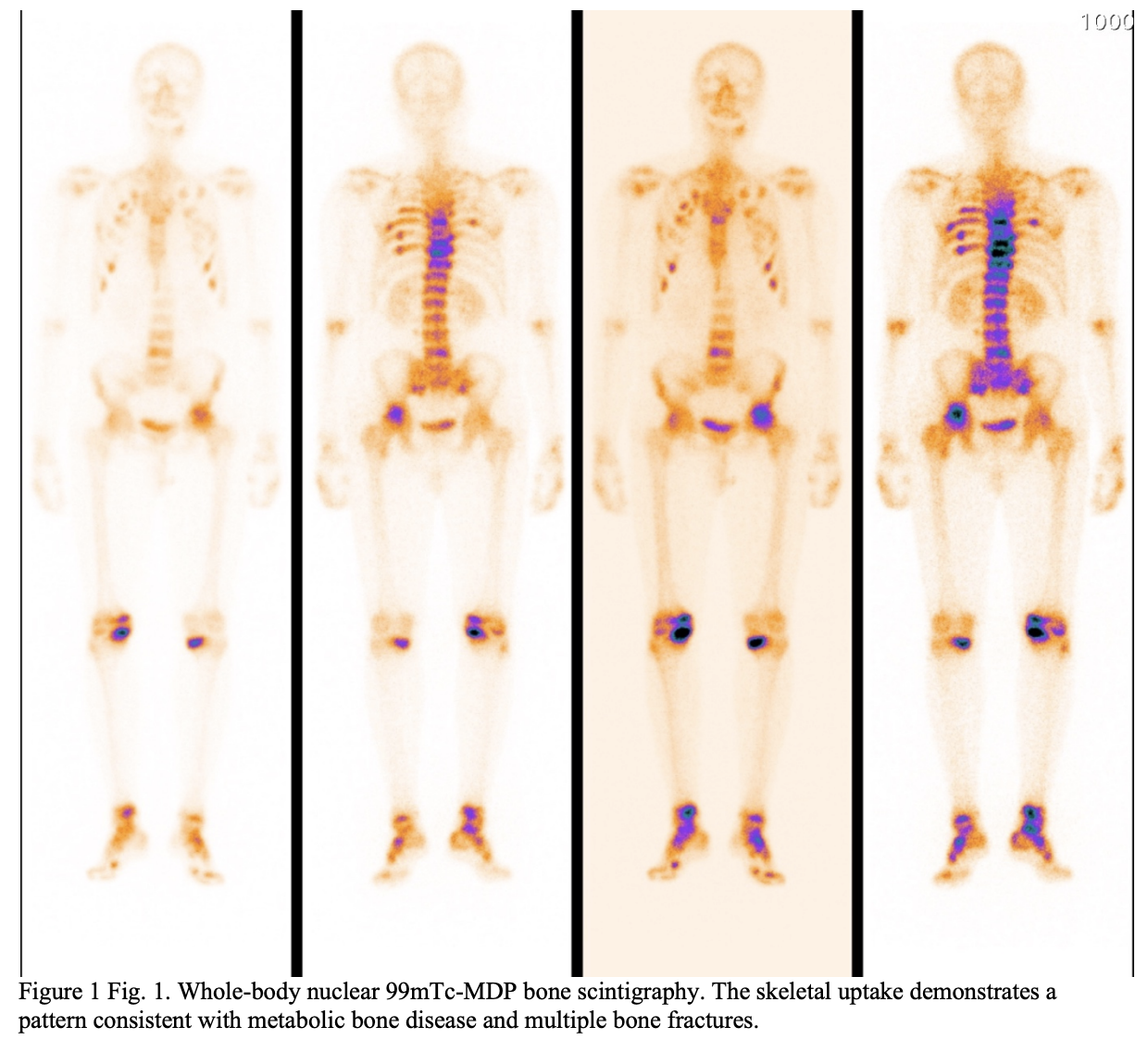
A whole body nuclear bone scintigraphy with
Technecium-99m Methyldiphosphonate
(99mTc-MDP) was performed showing
heterogenous uptake and multiple fractures of
ribs and vertebrae with no observable signs of
metastatic bone disease (Fig.1). However, the
pattern of uptake was consistent with metabolic
bone disease.
Bone densitometry with dual-energy X-ray
absorptiometry (DEXA) showed a T-score of -
4,4 consistent with osteoporosis.
In search of a possible lesion a whole-body CT
was performed, once more showing multiple
axial skeleton fractures due to osteoporosis
without observable tumours.
Following these findings, a whole-body scan
with 99mTc-Tectrotyd was performed showing
intense uptake in the paranasal sinus area (Fig 2).
No other focal uptake was seen.
A repeat questioning revealed that a year ago a
right paranasal sinus mass was discovered on CT
and MRI. A biopsy was done and histology came
back as capillary hemangioma. A full excision
was planned, however, due to COVID-19 the
operation was postponed.
A repeat reading of CT and MR images showed
a soft tissue mass in the right nasal cavity with
extension towards adjacent sinuses (Fig. 3 and
Fig. 4).
A complete surgical resection of the mass was
performed and after a pathologic review the
tumour was confirmed as PMT.
Journal of Medical Sciences. Mar 18, 2022 - Volume 10 | Issue 1. Electronic - ISSN: 2345-0592
82
Figure 1 Fig. 1. Whole-body nuclear 99mTc-MDP bone scintigraphy. The skeletal uptake demonstrates a
pattern consistent with metabolic bone disease and multiple bone fractures.
Journal of Medical Sciences. Mar 18, 2022 - Volume 10 | Issue 1. Electronic - ISSN: 2345-0592
83
Figure 2 Fig. 2. Whole-body scan with 99mTc-Tectrotyd. (Arrows) Demonstrates increased uptake in
paranasal sinus area.
Figure 3 Fig. 3. CT sinuses (coronal view). Shows a mass filling the right nasal cavity, right maxillary
and frontal sinuses and right ethmoidal cells with the destruction of conchae and the medial wall of the
right maxillary sinus.
Journal of Medical Sciences. Mar 18, 2022 - Volume 10 | Issue 1. Electronic - ISSN: 2345-0592
84
Figure 4 Fig. 4. MRI sinuses. (A) Axial T2 fat-suppressed, (B) axial T1, (C) axial T1 fat-suppressed post
contrast images demonstrate a soft tissue mass hyperintense on T2, iso-/hyperintense on T1 and with faint
non-homogenous enhancement post contrast.
Discussion
Clinical features
PMT is an extremely rare and diagnostically
challenging neoplasm, especially when it
develops in an uncommon site such as the
head or neck. Most osteomalacia-inducing
tumors are detected during the late fourth to
early fifth decades of life (4). PMT may
develope in almost any osseous location or
soft tissue (10). However, they are rare in
parenchymal organs or in retroperitoneum
(1,1113). PMT most often involves
extremities and acral sites in soft tissues. In
bones PMT commonly appears in the
appendicular skeleton, cranial bones and
paranasal sinuses (1,1013). Most PMTs are
solitary lesions, however, a patient with
multifocal PMT has been reported (14).
The diagnosis is delayed for a long time as it
is both a rare condition that is often excluded
from the list of differentials by treating
physicians and the patient’s symptoms, such
as muscle pain and progressive weakness, are
of non-specific nature (15). The typical
period from the onset of symptoms to the
clinical diagnosis of TIO is about three years,
and the average from the time of initial
presentation to tumor removal is more than
five years (13,16). PMT almost always
manifest with biochemical abnormalities that
show chronic hypophosphatemia without
manifesting symptoms of the tumor itself
(10). As the disease progresses bone pain and
fractures occur more often and account for a
large portion of the PMT related morbidity
(10,13).
The overwhelming majority of PMT are
benign and complete excision of the tumor
usually results in rapid resolution of
phosphate wasting and osteomalacia
(3,13,17).
Pathologic features
PMT is a type of connective tissue tumor that
is typically characterized by a specific
admixture of spindle cells, microcysts,
osteoclasts-like giant cells, cartilage-like
matrix , prominent blood vessels, and
extensive calcification (7).
Hemangiopericytoma was the most
frequently diagnosed PMT, seen in 70 to 80
percent of TIO cases, followed by
hemangioma, granuloma, ossifying fibroma
and giant cell tumor (3,12,18,19). In most
cases, osteomalacia is secondary to the tumor
cell production of FGF 23, but FGF 23
elevation is not specific of TIO. The
differential diagnosis of TIO are x-linked
hypophosphatemic, autosomal dominant and
recessive hypophosphatemic rickets (3,20).
Somatostatin receptor (SSTR) subtypes (1,
2A, 2B, 3, 4, 5) are expressed to a variable
degree in many tumors (3,12,19,2123). A
small subset of PMTs show malignant
histologic characteristic and can behave
clinically malignantly (24). Consequently, in
many cases PMT diagnosis is very difficult
for pathologists especially if the clinical
presentation of the lesion is unknown or if the
pathologist is not aware of the entity at all
(11).
Diagnostic imaging features
Journal of Medical Sciences. Mar 18, 2022 - Volume 10 | Issue 1. Electronic - ISSN: 2345-0592
85
Because PMTs have a wide range of
histopathological characteristics, it is more
important to distinguish this malignancy from
other vascular tumors before surgery.
However, conventional imaging modalities
such as radiography, CT and MRI also show
variable characteristics on imaging
(11,25,26). Some studies show, that even
with a combination of 111In-pentetreotide
single-photon emission computed
tomography (Octreoscan-SPECT/CT), F18-
fluorodeoxyglucose positron emision
tomography (18F FDG-PET/CT) and
anatomical localization studies (MRI and
CT), only 61 percent of subjects with TIO had
successful tumor localization (27).
The imaging features of PMT have only very
recently been described in detail (26).
Multiple pseudofractures, also known as
Looser-Milkman zones, are radiolucent
bands perpendicular to the cortex and are
usually bilateral and symmetrical. They are
most commonly located in the ribs, pubic
rami, external margin of scapula, internal
margin of the proximal femur, and metatarsal
bones (17). They can sometimes progress to
complete fractures (17).
DEXA helps to diagnose osteomalacia in
patients with TIO which results from the
disturbance of mineralization kinetics and
increased bone resorption by osteoclasts.
DEXA is useful in patient follow up to assess
recovery of bone mineral density (7).
On CT scans, the tumor exhibits a round or
oval, well-defined, isodense or hypodense
soft tissue mass and displays a uniform
enhancement, especially when the tumor is
small (25). Bone lesions are typically
osteolytic and characterized by a narrow
transition zone and the presence of internal
matrix (13). But CT has a limited role in
localizing the culprit tumor (11,25,26,28,29).
PMTs are usually T1 isointense, T2
hyperintense, and markedly homogeneous
enhancing on MRI, with areas of dark T2
signal indicating the presence of internal
matrix (11,25,26,2830). However, variable
tumor sizes result in various MRI imaging
findings (25). A large tumor can display
heterogeneous signal intensity on T2W and
T1W and heterogeneous enhancement on
post-contrast T1W (25). Within large tumors
the areas of heterogeneous low signals are
consistent with vascular flow voids (25).
PMTs can therefore be mistaken for other
bone and soft tissue neoplasms, such as
fibrous dysplasia, tenosynovial giant cell
tumor, and even atypical lipomatous tumor
(26). Similar to CT, the role of MRI is to
anatomically define the tumor before surgery,
especially in the sinonasal region, after
functional imaging has identified a possible
culprit tumor (7).
Bone scintigraphy is more sensitive than X-
rays and often shows multiple foci of uptake
at sites of insufficiency fractures or
pseudofractures, however, that may misdirect
the effort to localize the tumor. Increased
tracer uptake by the mandible, vertebral
column and the sternum creating the “tie
sign” may be seen in tumor-induced
osteomalacia (31). A generalized increase
tracer uptake (known as superscan) may also
be seen due to secondary
hyperparathyroidism, especially in the
cranium, chondrocostal joints, jaw (17,19).
Although nonspecific scintigraphy findings
can be confused with metastatic bone lesions
and other metabolic causes, including
vitamin D deficiency, drug abuse,
malabsorption, kidney insufficiency.
Increased tracer uptake in growth plates and
a prominent appearance of the costochondral
junction, known as the ‘rachitic rosary sign’,
are thought to be more specific of TIO and
should raise its suspicion if detected
(7,19,31,32).
Radionuclide scans are often particularly
valuable in the detection of occult PMT of the
soft tissues; as metabolically active
neoplasms, they may be identified with
111Indium-octreotide scintigraphy, 68Ga-
DOTATATE PET/CT and 18F-FDG
PET/CT (3,4,13,26,29,3335).
Some authors advocate 18F FDG-PET/CT
for localizing TIO (3,36,37). While 18F
FDG-PET/CT may be very sensitive, it is
non-specific and may identify areas of
increased metabolic activity that are not
related to the tumor (19). This is especially
true in patients who have many active
fracture healing regions (19). Because of the
physiological uptake in brain, liver, and
spleen, tumor detection in these sites may be
challenging, and additional imaging
modalities should be used to assess these
locations (26). Also, a variable degree of
FDG uptake in this group of tumors might be
accountable for the unsatisfactory detection
rate (26,36).
PMTs express SSTR and consistent
expression of the SSTR2A subtype has been
demonstrated (1,23,26). Somatostatin-
analogues, such as111Indium-octreotide or
Octreoscan, which has a high affinity to
somatostatin receptor SSTR 2, have been
Journal of Medical Sciences. Mar 18, 2022 - Volume 10 | Issue 1. Electronic - ISSN: 2345-0592
86
used to image these tumors (6,22,37,38). Tc-
99m-HYNIC-octreotide, a Tc-99m labeled
somatostatin analog has recently become
more popular and successful in imaging
somatostatin receptor expressing neoplasms
(7). Tc-99m-HYNIC-octreotide scintigraphy
has shown to be very useful to localize TIO
(39,40). Multiple reports have shown clinical
success of Octreoscan with combined
SPECT/CT in detection of FGF23 secreting
mesenchymal tumors (3). Pitfalls of these
agents include tracer uptake in inflammatory
conditions, which might be mistaken for bone
or soft tissue malignancy (41). Nasal mucosal
uptake may be seen in patients with a
common cold in Octreoscan and should not
be confused for sinonasal mesenchymal
tumors (42). Small lesion size, poor spatial
resolution of planar scintigraphy, insufficient
expression of the somatostatin receptor, or
adjacent location of bone fracture may be
contribute to false-negative findings
(3,4,6,43).
Somatostatin receptor PET/CT imaging with
Ga68 labeled DOTA conjugated peptides,
DOTATATE, DOTATOC, and DOTANOC,
has recently emerged as a promising imaging
method for localizing TIO-causing
mesenchymal tumors (35,11). 68Ga-
DOTATATE is an antagonist of the SSTR,
which is internalized after binding to the
receptor, leading in radioactivity
accumulation in neoplasm cells (44). The
higher affinity of DOTATATE for SSTR 2,
the receptor subtype predominantly
overexpressed, may favor its use in TIO over
DOTANOC and DOTATOC (45). 68Ga-
DOTATATE has shown greater spatial
resolution, higher sensitivity and specificity
over Octreoscan in detecting an occult tumor
(4). But some studies show that it is not more
sensitive than Octreoscan-SPECT/CT and
18F FDG-PET/CT combined
(4,9,19,35,45,46). False positive etiologies
(i.e., osteomalacia induced fractures,
inflammatory conditions) also present with
increased uptake and could occasionally be
confusing in the localization of primary
tumors (3). As with FDG PET/CT, it’s critical
to ensure that these imaging examinations
cover the entire body from vertex to toes,
including the hands and feet. Also, there is a
need for careful examination of the
craniofacial region which accounts for nearly
30% of the PMT (47).
Conclusion
While phosphaturic mesenchymal tumor is a
rare neoplasm, it is the most common cause
of tumor induced osteomalacia. The
diagnosis is delayed for years due to the non-
specific nature of symptoms, lack of clinical
suspicion and difficulty in identifying the
responsible tumor. Tumor induced
osteomalacia is often a diagnostic challenge,
however, advances in medical imaging have
enhanced the effective localization of
osteomalacia-inducing tumors. For
radiologists, raising the suspicion of a
phosphaturic mesenchymal tumor in any
patient presenting with osteomalacia as well
as localizing the tumor on imaging is crucial,
as complete excision of the tumor leads to
resolution of the osteomalacia and clinical
symptoms.
Conflict of interest
None.
References
1. Agaimy A, Michal M, Chiosea S, Petersson
F, Hadravsky L, Kristiansen G, et al.
Phosphaturic Mesenchymal Tumors:
Clinicopathologic, Immunohistochemical
and Molecular Analysis of 22 Cases
Expanding their Morphologic and
Immunophenotypic Spectrum. Am J Surg
Pathol. 2017;41(10):137180.
2. Carter JM, Caron BL, Dogan A, Folpe AL. A
novel chromogenic in situ hybridization
assay for FGF23 mRNA in phosphaturic
mesenchymal tumors. Am J Surg Pathol.
2015 Jan;39(1):7583.
3. Yang M, Doshi KB, Roarke MC, Nguyen
BD. Molecular Imaging in Diagnosis of
Tumor-induced Osteomalacia. Curr Probl
Diagn Radiol. 2019;48(4):37986.
4. El-Maouche D, Sadowski SM, Papadakis
GZ, Guthrie L, Cottle-Delisle C, Merkel R, et
al. 68Ga-DOTATATE for tumor localization
in tumor-induced osteomalacia. J Clin
Endocrinol Metab. 2016;101(10):357581.
5. von Falck C, Rodt T, Rosenthal H, Länger F,
Goesling T, Knapp WH, et al. (68)Ga-
DOTANOC PET/CT for the detection of a
mesenchymal tumor causing oncogenic
osteomalacia. Eur J Nucl Med Mol Imaging.
2008 May;35(5):1034.
6. Garcia CA, Spencer RP. Bone and In-111
octreotide imaging in oncogenic
Journal of Medical Sciences. Mar 18, 2022 - Volume 10 | Issue 1. Electronic - ISSN: 2345-0592
87
osteomalacia: a case report. Clin Nucl Med.
2002 Aug;27(8):5823.
7. Rayamajhi SJ, Yeh R, Wong T, Dumeer S,
Mittal BR, Remotti F, et al. Tumor-induced
osteomalacia Current imaging modalities
and a systematic approach for tumor
localization. Clin Imaging.
2019;56(January):11423.
8. Khosravi A, Cutler CM, Kelly MH, Chang R,
Royal RE, Sherry RM, et al. Determination of
the elimination half-life of fibroblast growth
factor-23. J Clin Endocrinol Metab. 2007
Jun;92(6):23747.
9. Ho CL. Ga68-DOTA Peptide PET/CT to
Detect Occult Mesenchymal Tumor-Inducing
Osteomalacia: A Case Series of Three
Patients. Nucl Med Mol Imaging (2010).
2015;49(3):2316.
10. Boland JM, Tebben PJ, Folpe AL.
Phosphaturic mesenchymal tumors: what an
endocrinologist should know. J Endocrinol
Invest [Internet]. 2018;41(10):117384.
Available from:
https://doi.org/10.1007/s40618-018-0849-5
11. Kawthalkar AS, Janu AK, Deshpande MS,
Gala KB, Gulia A, Puri A. Phosphaturic
Mesenchymal Tumors from Head to Toe:
Imaging Findings and Role of the Radiologist
in Diagnosing Tumor-Induced Osteomalacia.
Indian J Orthop [Internet]. 2020;54(2):215
23. Available from:
https://doi.org/10.1007/s43465-019-00005-5
12. Folpe AL, Fanburg-Smith JC, Billings SD,
Bisceglia M, Bertoni F, Cho JY, et al. Most
osteomalacia-associated mesenchymal
tumors are a single histopathologic entity: an
analysis of 32 cases and a comprehensive
review of the literature. Am J Surg Pathol.
2004 Jan;28(1):130.
13. Folpe AL. Phosphaturic mesenchymal
tumors: A review and update. Semin Diagn
Pathol. 2019;36(4):2608.
14. Arai R, Onodera T, Terkawi MA, Mitsuhashi
T, Kondo E, Iwasaki N. A rare case of
multiple phosphaturic mesenchymal tumors
along a tendon sheath inducing osteomalacia.
BMC Musculoskelet Disord. 2017
Feb;18(1):79.
15. Ledford CK, Zelenski NA, Cardona DM,
Brigman BE, Eward WC. The phosphaturic
mesenchymal tumor: why is definitive
diagnosis and curative surgery often
delayed? Clin Orthop Relat Res. 2013
Nov;471(11):361825.
16. Feng J, Jiang Y, Wang O, Li M, Xing X, Huo
L, et al. The diagnostic dilemma of tumor
induced osteomalacia: a retrospective
analysis of 144 cases. Endocr J. 2017
Jul;64(7):67583.
17. Alonso G, Varsavsky M. Tumour-induced
osteomalacia: An emergent paraneoplastic
syndrome. Endocrinol y Nutr (English Ed.
2016 Apr;63.
18. Carpenter TO. Oncogenic osteomalacia--a
complex dance of factors. Vol. 348, The New
England journal of medicine. United States;
2003. p. 17058.
19. Chong WH, Molinolo AA, Chen CC, Collins
MT. Tumor-induced osteomalacia. Endocr
Relat Cancer. 2011 Jun;18(3):R53-77.
20. Ramon I, Kleynen P, Body J-J, Karmali R.
Fibroblast growth factor 23 and its role in
phosphate homeostasis. Eur J Endocrinol.
2010 Jan;162(1):110.
21. Clifton-Bligh RJ, Hofman MS, Duncan E,
Sim I-W, Darnell D, Clarkson A, et al.
Improving diagnosis of tumor-induced
osteomalacia with Gallium-68 DOTATATE
PET/CT. J Clin Endocrinol Metab. 2013
Feb;98(2):687–94.
22. Duet M, Kerkeni S, Sfar R, Bazille C, Lioté
F, Orcel P. Clinical impact of somatostatin
receptor scintigraphy in the management of
tumor-induced osteomalacia. Clin Nucl Med.
2008 Nov;33(11):7526.
23. Houang M, Clarkson A, Sioson L, Elston MS,
Clifton-Bligh RJ, Dray M, et al. Phosphaturic
mesenchymal tumors show positive staining
for somatostatin receptor 2A (SSTR2A).
Hum Pathol. 2013 Dec;44(12):27118.
24. Qiu S, Cao L-L, Qiu Y, Yan P, Li Z-X, Du J,
et al. Malignant phosphaturic mesenchymal
tumor with pulmonary metastasis: A case
report. Medicine (Baltimore). 2017
Apr;96(17):e6750.
25. Shi Z, Deng Y, Li X, Li Y, Cao D, Coossa
VS. CT and MR imaging features in
phosphaturic mesenchymal tumor-mixed
connective tissue: A case report. Oncol Lett.
2018;15(4):49708.
26. Broski SM, Folpe AL, Wenger DE. Imaging
features of phosphaturic mesenchymal
tumors. Skeletal Radiol. 2019;48(1):11927.
27. Chong WH, Andreopoulou P, Chen CC,
Reynolds J, Guthrie L, Kelly M, et al. Tumor
localization and biochemical response to cure
in tumor-induced osteomalacia. J bone Miner
Res Off J Am Soc Bone Miner Res. 2013
Jun;28(6):138698.
28. Cowan S, Lozano-Calderon SA, Uppot RN,
Sajed D, Huang AJ. Successful CT guided
cryoablation of phosphaturic mesenchymal
tumor in the soft tissues causing tumor-
induced osteomalacia: a case report. Skeletal
Radiol. 2017 Feb;46(2):2737.
29. Ghorbani-Aghbolaghi A, Darrow MA, Wang
Journal of Medical Sciences. Mar 18, 2022 - Volume 10 | Issue 1. Electronic - ISSN: 2345-0592
88
T. Phosphaturic mesenchymal tumor (PMT):
Exceptionally rare disease, yet crucial not to
miss. Autops Case Reports. 2017;7(3):327.
30. Kaneuchi Y, Hakozaki M, Yamada H,
Hasegawa O, Tajino T, Konno S. Missed
causative tumors in diagnosing tumor-
induced osteomalacia with (18)F-FDG
PET/CT: a potential pitfall of standard-field
imaging. Hell J Nucl Med. 2016;19(1):468.
31. Sood A, Agarwal K, Shukla J, Goel R, Dhir
V, Bhattacharya A, et al. Bone scintigraphic
patterns in patients of tumor induced
osteomalacia. Vol. 28, Indian journal of
nuclear medicine : IJNM : the official journal
of the Society of Nuclear Medicine, India.
2013. p. 1735.
32. Chakraborty PP, Bhattacharjee R,
Mukhopadhyay S, Chowdhury S. “Rachitic
rosary sign” and “tie sign” of the sternum in
tumour-induced osteomalacia. BMJ Case
Rep. 2016 Feb;2016.
33. Hodgson SF, Clarke BL, Tebben PJ, Mullan
BP, Cooney WP 3rd, Shives TC. Oncogenic
osteomalacia: localization of underlying
peripheral mesenchymal tumors with use of
Tc 99m sestamibi scintigraphy. Endocr Pract
Off J Am Coll Endocrinol Am Assoc Clin
Endocrinol. 2006;12(1):3542.
34. Kawai S, Ariyasu H, Furukawa Y,
Yamamoto R, Uraki S, Takeshima K, et al.
Effective localization in tumor-induced
osteomalacia using (68)Ga-DOTATOC-
PET/CT, venous sampling and 3T-MRI.
Endocrinol diabetes Metab case reports.
2017;2017.
35. Singh D, Chopra A, Ravina M, Kongara S,
Bhatia E, Kumar N, et al. Oncogenic
osteomalacia: role of Ga-68 DOTANOC
PET/CT scan in identifying the culprit lesion
and its management. Br J Radiol. 2017
Apr;90(1072):20160811.
36. Jagtap VS, Sarathi V, Lila AR, Malhotra G,
Sankhe SS, Bandgar T, et al. Tumor-induced
osteomalacia: a single center experience.
Endocr Pract Off J Am Coll Endocrinol Am
Assoc Clin Endocrinol. 2011;17(2):17784.
37. Jadhav S, Kasaliwal R, Lele V, Rangarajan
V, Chandra P, Shah H, et al. Functional
imaging in primary tumour-induced
osteomalacia: relative performance of FDG
PET/CT vs somatostatin receptor-based
functional scans: a series of nine patients.
Clin Endocrinol (Oxf). 2014 Jul;81(1):317.
38. Wu W, Zhou Y, Wang Y, Liu L, Lou J, Deng
Y, et al. Clinical Significance of Somatostatin
Receptor (SSTR) 2 in Meningioma. Front
Oncol. 2020;10:1633.
39. Jing H, Li F, Zhong D, Zhuang H. 99mTc-
HYNIC-TOC (99mTc-hydrazinonicotinyl-
Tyr3-octreotide) scintigraphy identifying
two separate causative tumors in a patient
with tumor-induced osteomalacia (TIO). Clin
Nucl Med. 2013 Aug;38(8):6647.
40. Jin X, Jing H, Li F, Zhuang H. Osteomalacia-
inducing renal clear cell carcinoma
uncovered by 99mTc-Hydrazinonicotinyl-
Tyr3-octreotide (99mTc-HYNIC-TOC)
scintigraphy. Clin Nucl Med. 2013
Nov;38(11):9224.
41. Gabriel M, Decristoforo C, Donnemiller E,
Ulmer H, Watfah Rychlinski C, Mather SJ, et
al. An intrapatient comparison of 99mTc-
EDDA/HYNIC-TOC with 111In-DTPA-
octreotide for diagnosis of somatostatin
receptor-expressing tumors. J Nucl Med.
2003 May;44(5):70816.
42. Deep NL, Cain RB, McCullough AE,
Hoxworth JM, Lal D. Sinonasal phosphaturic
mesenchymal tumor: Case report and
systematic review. Allergy Rhinol
(Providence). 2014 Jan;5(3):1627.
43. Hendry DS, Wissman R. Case 165:
Oncogenic osteomalacia. Radiology. 2011
Jan;258(1):3202.
44. Dalm SU, Nonnekens J, Doeswijk GN, de
Blois E, van Gent DC, Konijnenberg MW, et
al. Comparison of the Therapeutic Response
to Treatment with a 177Lu-Labeled
Somatostatin Receptor Agonist and
Antagonist in Preclinical Models. J Nucl
Med. 2016 Feb;57(2):2605.
45. Agrawal K, Bhadada S, Mittal BR, Shukla J,
Sood A, Bhattacharya A, et al. Comparison of
18F-FDG and 68Ga DOTATATE PET/CT in
localization of tumor causing oncogenic
osteomalacia. Clin Nucl Med. 2015
Jan;40(1):e610.
46. Bhavani N, Reena Asirvatham A, Kallur K,
Menon AS, Pavithran P V, Nair V, et al.
Utility of Gallium-68 DOTANOC PET/CT in
the localization of Tumour-induced
osteomalacia. Clin Endocrinol (Oxf). 2016
Jan;84(1):13440.
47. Jiang Y, Xia W, Xing X, Silva BC, Li M,
Wang O, et al. Tumor-induced osteomalacia:
an important cause of adult-onset
hypophosphatemic osteomalacia in China:
Report of 39 cases and review of the
literature. J bone Miner Res Off J Am Soc
Bone Miner Res. 2012 Sep;27(9):196775.