The key radiologic features of sigmoid volvulus: a case report with a review of literature

Iveta Idzelytė 1, Tomas Lobinas 2, Vestina Strakšytė 2

1 Lithuanian University of Health Sciences, Academy of Medicine, Faculty of Medicine

2Department of Radiology, Hospital of Lithuanian University of Health Sciences Kaunas Clinics 

Abstract

Background: sigmoid volvulus is a cause of large bowel obstruction and occurs when the sigmoid colon twists on its mesentery. This condition requires prompt diagnosis and treatment for better disease outcomes. According to the literature, sigmoid volvulus typically develops in patients of an older age with other comorbidities.

Aim: to present a clinical case of SV and review the latest scientific literature, and to raise awareness of this life-threatening disease, which can be successfully treated due to timely diagnosis.

Methods: We presented a case report of a 33-year-old man with a sigmoid volvulus. After surgical treatment, the histopathological examination revealed Hirschsprung’s disease. Publications, researching the problem of sigmoid volvulus, were reviewed.

Conclusions: sigmoid volvulus is a life-threatening disease and radiological signs have an important value diagnosing this pathology and may help to determine the therapeutic approach. Plain abdominal radiography and CT are widely available diagnostics tools for making correct SV diagnosis.

Keywords: sigmoid volvulus, Hirschsprung’s disease, radiologic features.

Full article

Journal of Medical Sciences. June 30, 2020 - Volume 8 | Issue 18. Electronic - ISSN: 2345-0592
148
Medical Sciences 2020 Vol. 8 (18), p. 148-153
The key radiologic features of sigmoid volvulus: a case
report with a review of literature
Iveta Idzelytė
1
, Tomas Lobinas
2
, Vestina Strakšytė
2
1
Lithuanian University of Health Sciences, Academy of Medicine, Faculty of Medicine
2
Department of Radiology, Hospital of Lithuanian University of Health Sciences Kaunas Clinics
Abstract
Background: sigmoid volvulus is a cause of large bowel obstruction and occurs when the sigmoid colon twists on
its mesentery. This condition requires prompt diagnosis and treatment for better disease outcomes. According to the
literature, sigmoid volvulus typically develops in patients of an older age with other comorbidities.
Aim: to present a clinical case of SV and review the latest scientific literature, and to raise awareness of this life-
threatening disease, which can be successfully treated due to timely diagnosis.
Methods: We presented a case report of a 33-year-old man with a sigmoid volvulus. After surgical treatment, the
histopathological examination revealed Hirschsprung's disease. Publications, researching the problem of sigmoid
volvulus, were reviewed.
Conclusions: sigmoid volvulus is a life-threatening disease and radiological signs have an important value
diagnosing this pathology and may help to determine the therapeutic approach. Plain abdominal radiography and CT
are widely available diagnostics tools for making correct SV diagnosis.
Keywords: sigmoid volvulus, Hirschsprung's disease, radiologic features.
Journal of Medical Sciences. June 30, 2020 - Volume 8 | Issue 18. Electronic - ISSN: 2345-0592
149
Introduction
Sigmoid volvulus (SV) occurs when the sigmoid
colon twists axially around a narrow base of the
mesentery, leading to a closed-loop obstruction. This
condition can lead to strangulation, ischemia,
gangrene, or perforation (1). The sigmoid is the most
common site of colonic volvulus and accounts for
60%75% of all cases of colonic volvulus (2). It is
the third common cause of colon obstruction after
cancer and diverticular disease, and only 24% of
intestinal obstructions are caused by SV (3). The
mortality of SV is quite high, so prompt diagnosis,
especially radiological and adequate disease
management, are crucial.
We aim to present the clinical case of SV and to raise
awareness of this life-threatening disease, which can
be successfully treated due to timely diagnosis.
Case report
A 33-year-old previously healthy man presented to
the emergency department with acute onset of severe
abdominal pain that started 3 hours ago and
progressed during the time. The patient reported
symptoms of gas and stool retention and one episode
of emesis with undigested food. The patient had no
history of abdominal surgery or other diseases.
Upon arrival, the patient‘s blood pressure was 150/84
mmHg, pulse rate 92 beats per minute. All other
vital signs were stable. Physical examination revealed
diffuse abdominal distension and tenderness with no
signs of peritoneal irritation. The blood tests showed
mild leukocytosis 12.9 x 10⁹/l and elevated C-
reactive protein 41.1 mg/l. Also, hematuria and
proteinuria were found.
The abdomen ultrasonography examination was not
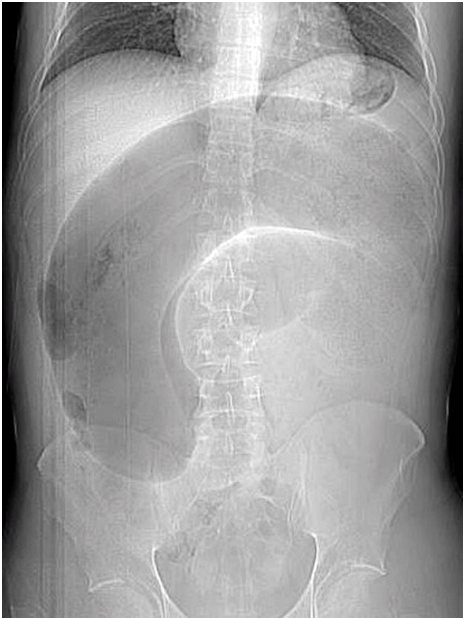
informative due to bowel distension. The plain
abdominal x-ray showed signs of bowel obstruction
(Figure 1). To identified the cause of bowel
obstruction, contrast-enhanced computed tomography
(CT) was performed. Computed tomography
scanning revealed a dilated sigmoid loop and twisting
of the mesenteric vessels (Figure 2).
The patient underwent sigmoid resection with a
stoma. Surprisingly the histopathological
examination revealed necrotic bowel changes and
Hirschsprung's disease. The patient was discharged
from hospital on the 8th postoperative day with good
general appearance and recommendation for
returning to follow up in the future for the closure of
the stoma.
Journal of Medical Sciences. June 30, 2020 - Volume 8 | Issue 18. Electronic - ISSN: 2345-0592
150
FIGURE 1. Supine plain films of the abdomen revealed a distended sigmoid loop with an inverted U configuration.
FIGURE 2. Sigmoid volvulus coronal computer tomography slices. a) Severe distention of the sigmoid extending
into the sub-phrenic region with an air-fluid level. Proximally, there is a moderate amount of stool throughout the
colon, b) as well as the “whirl sign” composed of the mesentery and twisted sigmoid loop.
2a
2b
Journal of Medical Sciences. June 30, 2020 - Volume 8 | Issue 18. Electronic - ISSN: 2345-0592
151
Discussion
With an aging population in the most developed
countries, the problem of an acute SV is expected to
become more prevalent (4). SV risk factors are
chronic constipation, prolonged bed rest,
hospitalization, high fiber diet, pregnancy, high
altitude, and megacolon (5). Many studies have found
that volvulus affects men and women equally. The
incidence of volvulus increases with age—the
average age at diagnosis 70 years (6).
However, some diseases can result in SV
development event if the patient is young and
healthy. These conditions are Hirschsprung’s disease,
omphalomesenteric abnormalities, intestinal
malrotation, anal stenosis, chronic constipation,
surgical adherence, prune belly syndrome, and
mental retardation (7, 8). Our patient was young
33-years-old, but the histopathology examination
confirmed Hirschsprung's disease. Hirschsprung’s
disease is characterized by a total absence of nerve
nodes along the colon’s entire length or only in a
segment of it. In the majority (80%) of patients, the
disease occurs in the recto-sigmoid region. An
aganglionic segment below the sigmoid colon and a
loose mesosigmoid seem to be responsible for the
volvulus development. Frequently, Hirschsprung’s
disease is diagnosed correctly only after acute
complications, such as obstructive colitis, SV, or
subacute obstruction (17). The reported patient was
unknown of the Hirschsprung’s disease only
presented SV and histopathology findings made it
clear.
The clinical signs of SV can be severe and occur
suddenly and include abdominal cramping, bloody
stools, constipation, nausea, vomiting, signs of shock
(if colonic perforation has occurred). The delayed
diagnosis and treatment often result in colonic
ischaemia with features of perforation and peritonitis
(9, 10). Younger patients may have an atypical
clinical sign with recurrent attacks of abdominal pain
with resolution due to the spontaneous detorsion (11).
In our case, the patient had complaints of acute
abdominal pain, gas and stool retention. His vital
signs were normal, and during the physical
examination, his abdomen was diffusely distended
and tender.
In our case, the ultrasonography was performed as a
primary test method. However, it was not as
informative as we could expect because of the large
amount of bowel gas. For a more accurate diagnosis,
a plain radiograph was indicated. The intestinal
obstruction was identified. The expected specific
signs as "coffee bean sign," "white stripe sign," were
not recognized. The plain abdominal x-ray is an
initial and rapid investigation. The radiologic features
include disproportionate sigmoid enlargement as a
large air-filled bowel loop without a haustral pattern,
which arises from the pelvis and extends cranially. It
may present various appearances: inverted U-shaped,
typical coffee bean shape ("coffee bean sign”), or
"white stripe sign" produced by the wall of interposed
loops (13). The contrast enema should be performed
in patients with no evidence of peritonitis and in
whom plain abdominal radiographs are not
informative. The contrast study typically
demonstrates a beak-like termination at the point of
the SV (15).
The contrast-enhanced CT scan was performed to
identify the site of obstruction. The CT-scan showed
the intestinal obstruction with markedly dilated
sigmoid bowel, "whirl sign," and no signs of
necrosis.
The CT scan findings are these: a massive gas-filled
loop lacking haustra forming a closed-loop
obstruction, a (this is seen when the bowel rotates
around its mesentery leading to the whirls of the
mesenteric vessels). It is essential to know that these
findings are not specific for the SV they can be
seen in the other types of volvulus too. The bird’s
beak sign represents gradual narrowing/tapering of
the sigmoid colon up to the level of obstruction
during contrast/barium insertion to the rectum or on
CT scan (12, 13). The benefit of the CT scan is the
ability to determine the degree of colonic distention,
signs of intestinal wall ischemia (14).
Laparotomy, as a treatment method, should be
selected when non-viability of the bowel is suspected
in the presence of compromised bowel signs and/or
Journal of Medical Sciences. June 30, 2020 - Volume 8 | Issue 18. Electronic - ISSN: 2345-0592
152
systemic sepsis signs like fever, dehydration, and
shock. In such cases, exploratory laparotomy should
be performed without any delay. The gangrenous
bowel should be excised, without detorsion and
minimal manipulation (16).
The prognosis and mortality in patients with SV
highly depend on the disease stage, surgical timing,
and comorbidities. SV should also be considered in
the younger patient, especially presenting with severe
abdominal pain and distention.
CONCLUSIONS
Sigmoid volvulus is a life-threatening disease and
radiological signs have an important value
diagnosing this pathology and may help to determine
the therapeutic approach. Plain abdominal
radiography and CT are widely available diagnostics
tools for making correct SV diagnosis.
REFERENCES
1. Salinas NL, Carr S, Han D, Mahmoud NN. A
surprising twist to an old problem: Sigmoid volvulus
in a 19-yearold man. Am Surg. 2007; 73:284-286.
2. Peterson CM, Anderson JS, Hara AK, Carenza JW,
Menias CO. Volvulus of the Gastrointestinal Tract:
Appearances at Multimodality Imaging.
RadioGraphics. 2009 m. rugsėjo 1 d.;29(5):128193.
3. Maddah G, Kazemzadeh GH, Abdollahi A, Bahar
MM, Tavassoli A, Shabahang H. Management of
Sigmoid Volvulus: Options and Prognosis. 2014
m.;24:5.
4. Baker DM, Wardrop PJ, Burrell H, Hardcastle JD.
The management of acute sigmoid volvulus in
Nottingham. J R Coll Surg Edinb.
1994;39(5):304‐306.
5. Grossmann EM, Longo WE, Stratton MD, Virgo
KS, Johnson FE. Sigmoid volvulus in Department of
Veterans Affairs Medical Centers: Diseases of the
Colon & Rectum. 2000 m. kovo;43(3):4148.
6. C. Michael Gibson, M.S., M.D, Hadeel Maksoud
M.D. Volvulus epidemiology and demographics,
2018 m. sausio 9 d. [žiūrėta 2020 m. gegužės 26 d.];
Adresas:
https://www.wikidoc.org/index.php/Volvulus_epide
miology_and_demographics
7. Choudhury CR, Ghosh D, Biswas S. Sigmoid
volvulus in a young patient: Beware of Hirschprung’s
disease. Saudi Surg J, 2013;1:29-31.
8. On behalf of the French-speaking Pediatric
Hepatology Gastroenterology and Nutrition Group
(GFHGNP), Colinet S, Rebeuh J, Gottrand F, Kalach
N, Paquot I, ir kt. Presentation and endoscopic
management of sigmoid volvulus in children. Eur J
Pediatr. 2015 m. liepos;174(7):9659.
9. Department of Surgery - Volvulus (Twisting of the
Colon) [Prieiga per internetą]. [žiūrėta 2020 m.
gegužės 26 d.]. Adresas:
https://surgery.ucsf.edu/conditions--
procedures/volvulus-(twisting-of-the-colon).aspx
10. Sigmoid Volvulus. Learn about sigmoid volvulus
[Prieiga per internetą]. [žiūrėta 2020 m. gegužės 26
d.]. Adresas: https://patient.info/doctor/sigmoid-
volvulus
11. Krupsky S, Halevy A, Orda R. Sigmoid volvulus
in adolescence. J Clin Gastroenterol.
1987;9(4):467‐469
12. Jones J. Sigmoid volvulus | Radiology Reference
Article | Radiopaedia.org [Prieiga per internetą].
Radiopaedia. [žiūrėta 2020 m. gegužės 26 d.].
Adresas: https://radiopaedia.org/articles/sigmoid-
volvulus
13. Ramirez R. Volvulus: clinical and radiologic
characteristics [Prieiga per internetą]. ECR 2012
PosterNG. European Congress of Radiology 2012;
2012 [žiūrėta 2020 m. gegužės 26 d.]. Adresas:
https://posterng.netkey.at/esr/viewing/index.php?mod
ule=viewing_poster&task=&pi=110234
14. Perrot L, Fohlen A, Alves A, Lubrano J.
Management of the colonic volvulus in 2016. Journal
of Visceral Surgery. 2016 m. birželio;153(3):18392.
15. What is the role of barium enema in the workup
of sigmoid and cecal volvulus? [Prieiga per
internetą]. [žiūrėta 2020 m. gegužės 26 d.]. Adresas:
https://www.medscape.com/answers/2048554-
Journal of Medical Sciences. June 30, 2020 - Volume 8 | Issue 18. Electronic - ISSN: 2345-0592
153
81646/what-is-the-role-of-barium-enema-in-the-
workup-of-sigmoid-and-cecal-volvulus
16. Turan M, Sen M, Karadayi K, et al. Our sigmoid
colon volvulus experience and benefits of
colonoscope in detortion process. Rev Esp Enferm
Dig. 2004;96(1):32‐35.
17. Alagumuthu M, Jagdish S, Kadambari D.
Hirschsprung’s disease in adults presenting as
sigmoid volvulus: a report of three cases. Tropical
Gastroenterology. 2012 m. sausio 31 d.;32(4):341–3