Misdiagnosed scabies leads to hyperinfestation in an immobile patient: a case report of crusted scabies and its alternative treatment

Monika Macejevska1, Jonas Lauraitis1, Jūratė Grigaitienė1,2

1Vilnius University Hospital Santaros Klinikos, Center of Dermatovenereology, Vilnius, Lithuania

2Vilnius University Faculty of Medicine, Institute of Clinical Medicine, Clinic of Chest Diseases, Dermatovenereology and Allergology, Center of Dermatovenereology, Vilnius, Lithuania

Abstract

 Background. Crusted scabies is rare, highly contagious parasitic infestation caused by human mite Sarcoptes scabiei var. hominis and predominantly manifesting in immunocompromised patients. Due to insidious beginning, misdiagnosis is likely which may result in an outbreak of the infection. In countries where oral ivermectin is unavailable, treatment of crusted scabies presents a challenge.

Case report. An 84-year-old immobile female patient with underlying malignancy was diagnosed with crusted scabies and successfully treated with keratolytic agents, surgical removal of crusts, permethrin cream, followed by daily applications of benzyl benzoate solution. Patient’s condition improved markedly after 14 days of treatment. However, 9 family members and part of medical staff became infected.

Conclusions: a combination of keratolytic agents, surgical removal of infected masses and topical scabicidal medications is equally effective treatment method for crusted scabies.

Keywords: scabies, crusted scabies, keratolytic, sulphur, surgical removal.


Full article

Journal of Medical Sciences. March 23, 2020 - Volume 8 | Issue 13. Electronic-ISSN: 2345-0592
53
Medical Sciences 2020 Vol. 8 (13), p. 53-59
Misdiagnosed scabies leads to hyperinfestation in an immobile
patient: a case report of crusted scabies and its alternative
treatment
Monika Macejevska
1
, Jonas Lauraitis
1
, Jūratė Grigaitienė
1,2
1
Vilnius University Hospital Santaros Klinikos, Center of Dermatovenereology, Vilnius, Lithuania
2
Vilnius University Faculty of Medicine, Institute of Clinical Medicine, Clinic of Chest Diseases,
Dermatovenereology and Allergology, Center of Dermatovenereology, Vilnius, Lithuania
Abstract
Background. Crusted scabies is rare, highly contagious parasitic infestation caused by human mite Sarcoptes
scabiei var. hominis and predominantly manifesting in immunocompromised patients. Due to insidious
beginning, misdiagnosis is likely which may result in an outbreak of the infection. In countries where oral
ivermectin is unavailable, treatment of crusted scabies presents a challenge.
Case report. An 84-year-old immobile female patient with underlying malignancy was diagnosed with crusted
scabies and successfully treated with keratolytic agents, surgical removal of crusts, permethrin cream, followed
by daily applications of benzyl benzoate solution. Patient’s condition improved markedly after 14 days of
treatment. However, 9 family members and part of medical staff became infected.
Conclusions: a combination of keratolytic agents, surgical removal of infected masses and topical scabicidal
medications is equally effective treatment method for crusted scabies.
Keywords: scabies, crusted scabies, keratolytic, sulphur, surgical removal.
e-ISSN: 2345-0592 Medical Sciences
Online issue
Indexed in Index Copernicus Official website:
www.medicsciences.com
Journal of Medical Sciences. March 23, 2020 - Volume 8 | Issue 13. Electronic-ISSN: 2345-0592
54
Introduction
Crusted scabies is rare, highly contagious parasitic
infestation caused by human mite Sarcoptes scabiei var.
hominis and predominantly manifesting in
immunocompromised patients (1). Other risk factors for
the disease include sensory neuropathy, dementia,
physical or mental debilitation, topical potent steroids,
limited access to bathing, underlying psoriasis etc (25).
The infection spreads via direct skin-to-skin contact or
by contact with infested fomites (6,7). Contrary to
conventional scabies, the hallmark lesion of crusted
scabies is hyperkeratotic, fissured plaques covered with
yellowish crusts whose thickness varies from 3- 15 mm
(8). Limbs, trunk, and scalp are most commonly
affected. However, if left untreated, the disease spreads
fast and may involve the entire integument, sometimes
leading to erythroderma, secondary bacterial infections
and other complications (8). Diagnosis is confirmed by
a microscopic examination of skin scrapings that reveal
mites, eggs or fecal pellets (6). Characteristic burrows
and intense pruritus are usually absent and that in some
cases leads to misdiagnosis followed by inappropriate
treatment (9). Moreover, an undiagnosed case of crusted
scabies may be the cause of an outbreak of scabies in
health care and residential facilities (1).
Herein we present a case of crusted scabies in an
immobile patient with underlying malignancy when
misdiagnosis led not only to generalized cutaneous
involvement but also 9 family members and part of
medical staff were infected.
Case report
An 84- year old female presented to university hospital,
Dermatovenereology unit in Vilnius, Lithuania, in
October 2018. She complained of marked
hyperkeratosis of whole body, itchy and flaking skin.
Her skin condition had been gradually worsening for 1,5
years, when generalized itch and skin rash first
appeared. Since then various treatments, (including
topical and intralesional corticosteroids), suspecting
unspecified dermatitis, have been unsuccessfully
attempted. In August 2018, the patient was admitted to
peripheral hospital, Nephrology and Urology unit
because of urinary bladder tumor that initially
manifested as bilateral hydronephrosis. For this reason,
bilateral nephrostomies were formed. Treatment of
dermatitis, consisting of various forms of
corticosteroids, continued. Due to the patient‘s
immobility and lack of possibilities to bath, the patient
hadn‘t bathed for 4 months. Lately diffuse marked
hyperkeratosis, prominent scale developed and
accordingly, she was admitted to Dermatovenereology
unit in a tertiary care hospital. Her other medical history
is irrelevant.
On physical examination, diffuse skin scaling and
marked hyperkeratosis with fissures was noted in
interdigital spaces, under neck, on the chest, on calves
and on the back. All nails were dystrophic with
Journal of Medical Sciences. March 23, 2020 - Volume 8 | Issue 13. Electronic-ISSN: 2345-0592
55
prominent subungual hyperkeratosis. Skin condition on
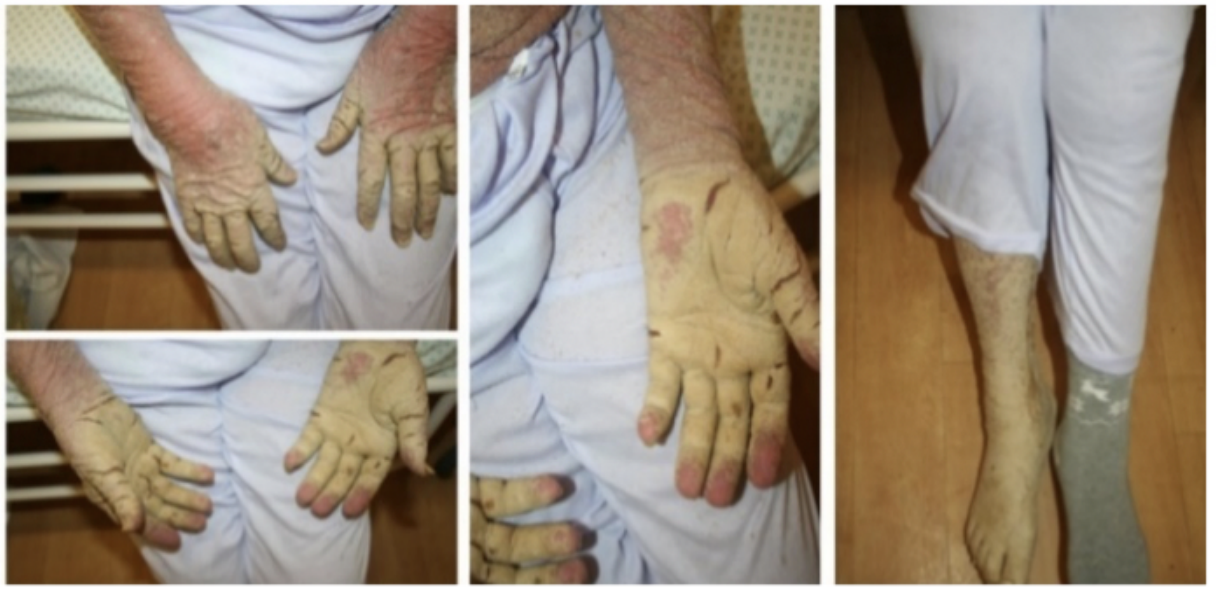
admission day is shown in Figures 1a and 1b.
Total blood count was relevant for lymphopenia
(0,8*10e9/l), eosinophilia (2,3*10e9/l), anemia
(hemoglobin 107 g/l, erythropenia 3,21*10e12/l).
Biochemical blood analysis showed increased levels of
immunoglobulin E (268,7 U/l), C- reactive protein
(CRP) (22,8 mg/) and urea (11,3 mmol/l). Microscopy
of skin scrapings taken from multiple body sites
revealed abundance of live mites (Figure 2), and
diagnosis of crusted scabies was made.
Having the diagnosis confirmed, scabicidal treatment
was initiated. Firstly, it consisted of daily bathing,
application of salicylic acid- sulphur 5% ointment on
affected areas under occlusion for 5 days as well as
mechanical removal of crusts (Figure 3). Once the crusts
had been removed, permethrin 5% cream was applied
for three days, next followed by application of benzyl
benzoate 20% solution to the whole body daily.
Additionally, oral antihistamine (clemastine 1 mg) was
given. Subungual areas were treated with daily
applications of salicylic acid- sulphur 5% ointment
under occlusion and mechanical removal of infected
masses.
The patient‘s condition improved markedly after 14
days of treatment. Crusts were removed almost
completely; the itch was greatly reduced. Skin condition
on discharge day is shown in Figures 4a and 4b. Despite
the fact that repeated microscopic analysis of skin
scrapings was negative for mites, for outpatient
treatment, she was recommended to continue salicylic
acid ointment daily, permethrin 5% cream every fourth
day for one week, nail trimming every 3
rd
day because
of very high mite load in nail debris. After 2 weeks an
appointment was scheduled to evaluate the condition of
the patient, unfortunately, she did not come and so the
outcome remains unknown.
The patient infested at least nine family members (her
husband, son, daughter, 2 granddaughters, their
husbands, 2 great- grandchildren). All of them were
diagnosed with conventional scabies, but only son’s and
husband’s microscopic evaluation of skin scrapings
revealed mites. Patient’s son and husband were admitted
to the same hospital. They received in-patient scabicidal
treatment with permethrin 5% cream for 3 days, next
followed by daily application of benzyl benzoate 20%
solution. In addition, the son helped to nurse, bath the
patient and remove the crusts mechanically, in such way
limiting the spread of the disease. Other family
members, whose skin lesions were not so prominent,
received outpatient scabicidal treatment consisting of
permethrin 5% cream.
Moreover, part of previous medical staff that nursed the
patient in Nephrology and Urology unit, also became
infected. Unfortunately, the total number of infested
persons remains unknown. To our knowledge, they all
received scabicidal treatment with benzoyl benzoate
20% solution for two days, with reapplication in need
after 7 days.
Journal of Medical Sciences. March 23, 2020 - Volume 8 | Issue 13. Electronic-ISSN: 2345-0592
56
Journal of Medical Sciences. March 23, 2020 - Volume 8 | Issue 13. Electronic-ISSN: 2345-0592
57
Figures 1a and 1 b. Patient’s condition on admission day.
Figure 2. Live mites (1, 2, 3) seen in microscopic evaluation of skin scrapings.
Figure 3. Mechanical removal of crusts.
Figures 4a and 4b. Patient’s skin condition on discharge day.
Discussion
Crusted scabies is a severe variant of highly contagious
scabies. Often course of the disease is insidious because
the eruption is slow in onset. Moreover, sometimes this
infestation might present as psoriasiform dermatitis
(10,11), which only makes it harder to determine the real
diagnosis. The disease mimics a wide variety of other
cutaneous disorders, for example, eczema, seborrheic
dermatitis, pityriasis rubra pilaris, cutaneous
lymphoma or ichthyosis vulgaris (8). For this reason,
misdiagnosed and mistreated scabies poses a significant
public health risk because patients with crusted scabies
have millions of mites on the skin, as opposed to tens of
mites found on skin in case of ordinary scabies (12,13).
Early recognition and proper treatment of the disease is
crucial to prevent widespread outbreaks. For example,
there was a scabies outbreak reported at Kettering
Medical Center in January 2017, when 86 employees
were infected (12). In our case, 9 family members and
unknown number of medical staff became infected.
Therefore, whenever a patient presents with atypical
psoriasis, keratoderma, diagnosis of crusted scabies
should be considered (9).
Apart from typical hyperkeratotic, fissured lesions on
extensor surfaces, other characteristic feature of crusted
scabies is dystrophic nails. Because of abundant
psoriasis- like subungual hyperkeratosis and debris, the
nails are the main source of relapse (8,14). In addition,
there are case reports of crusted scabies where a novel
clinical sign of the disease is described, i. e. reverse
pattern focal palmoplantar keratoderma, which spares
the most common pressure points, but instead affects the
areas of least friction or pressure. As authors suggest,
this symptom may aid in early diagnosis and treatment
of crusted scabies (13). However, this case was not
suitable to apply the symptom because of diffuse
distribution of hyperkeratotic lesions.
Once crusted scabies are diagnosed, it is of crucial
importance to look for underlying malignancy or other
immunosuppressive condition (2,9). Patients with
compromised immune system show abnormal
inflammatory response and hyperkeratotic reaction (15).
Hyperkeratosis is related to increased levels of IL- 4,
whereas cytotoxic T- cells play a part in imbalanced
dermal inflammation (16). These factors along with the
lack of B- cells results in skin failure to suppress
proliferation of mites (8). Uncontrolled growth of
parasites leads not only to very high contagion of the
disease, but is also responsible for peripheral
eosinophilia as well as increased levels of
immunoglobulin E and immunoglobulin G (8,12), as is
demonstrated in this case.
Treatment of crusted scabies is rather challenging.
Aggravating factors include compromised immunity,
high mite burden and, most importantly, limited
penetration of topical scabicidal medication into thick
hyperkeratotic plaques (12). For this reason, we initially
applied salicylic acid- sulphur 5% ointment. It acted as
a keratolytic agent, i. e. softened thick hyperkeratotic
plaques so they could be removed mechanically with a
surgical blade, and sulphur is the oldest scabicidal
medication whose efficacy, according to published
investigations, varies from 45,2 -52% (17,18). Once the
crusts had been removed, scabicidal treatment with
permethrin 5%, followed by application of benzyl
benzoate 20% solution was started. Permethrin
Journal of Medical Sciences. March 23, 2020 - Volume 8 | Issue 13. Electronic-ISSN: 2345-0592
58
preparations are treatment of choice in many countries
because of high efficacy and low toxicity (18). Although
oral ivermectin is strongly recommended in cases of
crusted scabies (19), the drug was not present in market
in Lithuania at given time, so alternative treatment
strategies had to be applied, in this case- combination of
various topical scabicidal medications. In addition, there
are cases reported where currently available acaricidal
agents are ineffective so there is need for the
development of different treatment modalities (20).
In conclusion, crusted scabies is highly contagious
parasitic infestation, which usually manifests in
immunocompromised, elderly and immobile patients
who lack access to bath. Due to insidious presentation
and not so prominent typical symptoms, misdiagnosis is
possible, which leads to widespread outbreaks. In
countries where oral ivermectin is unavailable,
mechanical removal of crusts followed by application of
combined topical scabicidal medications is equally
effective treatment method.
References
1. Crusted Scabies | NEJM [Internet]. [cited 2019 Jan
23]. Available from:
https://www.nejm.org/doi/full/10.1056/NEJMicm
1616169
2. Ghosh T, Jandhyala D, Bhatti MM, Pritt BS. The
Brief Case: Crusted Scabies in a Leukemic Patient
following a Stay in a Long-Term Acute Care
Facility. J Clin Microbiol. 2017;55(5):12336.
3. Sánchez-Borges M, González-Aveledo L,
Capriles-Hulett A, Caballero-Fonseca F. Scabies,
crusted (Norwegian) scabies and the diagnosis of
mite sensitisation. Allergol Immunopathol (Madr).
2018 Jun;46(3):27680.
4. Lima FC da R, Cerqueira AMM, Guimarães MBS,
Padilha CB de S, Craide FH, Bombardelli M.
Crusted scabies due to indiscriminate use of
glucocorticoid therapy in infant. An Bras
Dermatol. 2017;92(3):3835.
5. Ferreira AA, Esteves A, Mahia Y, Rosmaninho A,
Silva A. An Itchy Problem: A Clinical Case of
Crusted Scabies. Eur J Case Rep Intern Med.
2017;4(5):000591.
6. Salavastru CM, Chosidow O, Boffa MJ, Janier M,
Tiplica GS. European guideline for the
management of scabies. J Eur Acad Dermatol
Venereol JEADV. 2017 Aug;31(8):124853.
7. Banerji A. Scabies. Paediatr Child Health. 2015
Oct;20(7):3958.
8. Karthikeyan K. Crusted scabies. Indian J Dermatol
Venereol Leprol. 2009 Jul 1;75(4):340.
9. Yélamos O, Mir-Bonafé JF, López-Ferrer A,
Garcia-Muret MP, Alegre M, Puig L. Crusted
(Norwegian) scabies: an under-recognized
infestation characterized by an atypical
presentation and delayed diagnosis. J Eur Acad
Dermatol Venereol JEADV. 2016 Mar;30(3):483
5.
10. Yari N, Malone CH, Rivas A. Misdiagnosed
crusted scabies in an AIDS patient leads to
hyperinfestation. Cutis. 2017 Mar;99(3):2024.
11. Garofalo V, Saraceno R, Milana M, Lenci I,
Angelico M, Orlandi A, et al. Crusted scabies in a
liver transplant patient mimicking rupioid
psoriasis. Eur J Dermatol EJD. 2016 Oct
1;26(5):4956.
12. Seidelman J, Garza RM, Smith CM, Fowler VG.
More than a Mite Contagious: Crusted Scabies.
Am J Med. 2017;130(9):10424.
13. Slape DR-ML, McMeniman E, Currie BJ, Menz J.
Clinical diagnosis of crusted scabies: Reverse
focal pattern of plantar keratoderma. Australas J
Dermatol. 2018 Aug;59(3):2335.
14. Rose W, Rajendran G, Peter J. Crusted scabies.
Indian Pediatr. 2014 Aug;51(8):680.
15. Maghrabi MM, Lum S, Joba AT, Meier MJ,
Holmbeck RJ, Kennedy K. Norwegian crusted
scabies: an unusual case presentation. J Foot Ankle
Journal of Medical Sciences. March 23, 2020 - Volume 8 | Issue 13. Electronic-ISSN: 2345-0592
59
Surg Off Publ Am Coll Foot Ankle Surg. 2014
Feb;53(1):626.
16. Liu X, Walton SF, Murray HC, King M, Kelly A,
Holt DC, et al. Crusted scabies is associated with
increased IL-17 secretion by skin T cells. Parasite
Immunol. 2014 Nov;36(11):594604.
17. Abdel-Raheem TA, Méabed EMH, Nasef GA,
Abdel Wahed WY, Rohaim RMA. Efficacy,
acceptability and cost effectiveness of four
therapeutic agents for treatment of scabies. J
Dermatol Treat. 2016 Oct;27(5):4739.
18. Alipour H, Goldust M. The efficacy of oral
ivermectin vs. sulfur 10% ointment for the
treatment of scabies. Ann Parasitol.
2015;61(2):7984.
19. Wang MK, Chin-Yee B, Lo CK-L, Lee S, El-
Helou P, Alowami S, et al. Crusted scabies in a
renal transplant recipient treated with daily
ivermectin: A case report and literature review.
Transpl Infect Dis Off J Transplant Soc. 2019
Jun;21(3):e13077.
20. Gopinath H, Aishwarya M, Karthikeyan K.
Tackling scabies: novel agents for a neglected
disease. Int J Dermatol. 2018 Nov;57(11):12938.