Aryepiglottic cyst in young adult. A clinical case report

Andrius Račiūnas1 

1Royal London Hospital, Barts Health NHS Trust, Ear, Nose & Throat department, London, United Kingdom

Abstract

Introduction. Laryngeal cysts are benign fluid-filled non-infected sacs that can appear in different anatomical parts of the larynx. They are most commonly found in the supraglottic area. Symptoms include voice changes, foreign body sensation, snoring, obstructive sleep apnea, sore throat, dysphagia/odynophagia, dyspnea, however, most of the cysts found are incidental. Flexible nasendoscope and CT/MRI is used to diagnose and microlaryngoscopy and a laser is the main method of removing laryngeal cysts.

Clinical case. A 25-year-old gentleman presented to ENT Head & Neck clinic following a 2-month history of progressive difficulty in swallowing, hoarse voice, difficulty in breathing, and wheezing. A flexible nasendoscopy was performed which identified a large ball shape 4 cm supraglottic cyst in the right aryepiglottic fold which was valving and blocking the view of his vocal cords. A patient was taken to the theatre on the same day due to late presentation and fear that the cyst may rupture and cause airway problems. He had a microlaryngoscopy and laser excision of the right aryepiglottic fold cyst.

Conclusion. A patient who presented with longstanding and progressive airway symptoms should be urgently seen in the A&E. Late presentation increases the risk of sudden death due to airway deterioration. It is important to collect any comprehensive history before any anaesthesia. CT/MRI is recommended for preoperative planning. In some cases, time can be limited due to the risk of sudden airway deterioration.

Keywords. Laryngeal cyst, aryepiglottic cyst, airway emergency.

Journal of Medical Sciences. May 4, 2022 - Volume 10 | Issue 2. Electronic - ISSN: 2345-0592
46
Medical Sciences 2022 Vol. 10 (2), p. 46 - 50, https://doi.org/10.53453/ms.2022.05.6
Aryepiglottic cyst in young adult. A clinical case report
Andrius Račiūnas
1
1
Royal London Hospital, Barts Health NHS Trust, Ear, Nose & Throat department, London, United
Kingdom
Abstract
Introduction. Laryngeal cysts are benign fluid-filled non-infected sacs that can appear in different
anatomical parts of the larynx. They are most commonly found in the supraglottic area. Symptoms include
voice changes, foreign body sensation, snoring, obstructive sleep apnea, sore throat,
dysphagia/odynophagia, dyspnea, however, most of the cysts found are incidental. Flexible nasendoscope
and CT/MRI is used to diagnose and microlaryngoscopy and a laser is the main method of removing
laryngeal cysts.
Clinical case. A 25-year-old gentleman presented to ENT Head & Neck clinic following a 2-month history
of progressive difficulty in swallowing, hoarse voice, difficulty in breathing, and wheezing. A flexible
nasendoscopy was performed which identified a large ball shape 4 cm supraglottic cyst in the right
aryepiglottic fold which was valving and blocking the view of his vocal cords. A patient was taken to the
theatre on the same day due to late presentation and fear that the cyst may rupture and cause airway
problems. He had a microlaryngoscopy and laser excision of the right aryepiglottic fold cyst.
Conclusion. A patient who presented with longstanding and progressive airway symptoms should be
urgently seen in the A&E. Late presentation increases the risk of sudden death due to airway deterioration.
It is important to collect any comprehensive history before any anaesthesia. CT/MRI is recommended for
preoperative planning. In some cases, time can be limited due to the risk of sudden airway deterioration.
Keywords. Laryngeal cyst, aryepiglottic cyst, airway emergency.
Journal of Medical Sciences. May 4, 2022 - Volume 10 | Issue 2. Electronic - ISSN: 2345-0592
47
Introduction
Laryngeal cysts are benign fluid-filled non-infected
sacs that can appear in different anatomical parts of
the larynx. 58.2% of them are most commonly seen
in the supraglottic area, such as epiglottis and
vallecula, 18.3% in ventricular folds, and about
2.2% can be found in the aryepiglottic fold area
(1,3,5). Laryngeal cysts constitute approximately
from 5% to 10% of all benign laryngeal lesions.
They are more common in men but appear to be
more symptomatic in women (3).
In 1933 Myerson classification, laryngeal cysts are
classified into 4 categories: retention,
embryonic/congenital, vascular, and traumatic cysts
(6). Laryngeal cysts can also be classified into two
categories: ductal and saccular. Ductal cysts are
similar to mucus retention cysts and lie within the
mucus membrane whereas saccular cysts are larger
and are completely submucosal(4).
Most laryngeal cysts are asymptomatic and
incidentally diagnosed during routine laryngoscopy
or endoscopic examinations in adults(8). Other
patients can present with symptoms of voice
changes, foreign body sensation, snoring, neck
swelling, sore throat, dysphagia, and odynophagia.
Dyspnoea is the most common complaint (3,6).
Nasopharyngolaryngoscopy or flexible
nasendoscope and CT/MRI are required to
diagnose, narrow differential, and ensure precise
removal of the cyst (3,9).
Laryngeal cysts are most commonly removed by
excising the entire cyst with a microlaryngoscopic
approach and laser. Needle aspiration can also be
performed, however, it is normally avoided due to
the risk of the airway being compromised and a high
recurrence rate (3,7). It was also demonstrated that
the cyst can be removed with transoral
marsupialization, however, entire cyst excision
remains as a gold standard in most cases (10).
A case report
A 25-year-old man presented to Ear, Nose & Throat
(ENT) Head & Neck clinic following a 2-month
history of progressive difficulty in swallowing,
change in voice, difficulty in breathing, and
wheezing.
The patient has a past medical history of renal
transplant. He also has a family history of renal
disease and renal replacement therapy.
Journal of Medical Sciences. May 4, 2022 - Volume 10 | Issue 2. Electronic - ISSN: 2345-0592
48
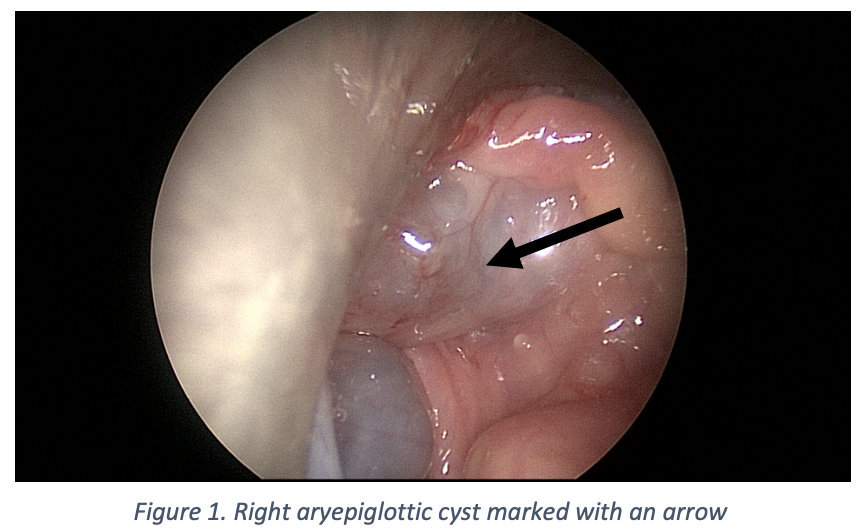
Figure 1. Right aryepiglottic cyst marked with an arrow
The patient initially presented to his GP surgery on
16/12/2021 where he was seen by general
practitioner. He was noted to have sore throat and
hoarseness of the voice for which he received a
course of oral antibiotics with no symptomatic
improvement. Simultaneously, he was also seen by
the renal team who has recently started
haemodialysis following progressive dysfunction of
his kidney transplant secondary to rejection. The
renal team noticed that his throat symptoms are
slowly progressing and getting worse they called
ENT team on 20/01/2022 to discuss sore throat
symptoms and refer the patient to the clinic.
Eventually, an ENT Head & Neck clinic follow up
appointment was organised within 2 weeks.
The patient was seen on 01/02/22 in the ENT Head
& Neck clinic. A flexible nasendoscopy was
performed which identified a large ball shape 4 cm
supraglottic cyst in the right aryepiglottic fold
which was valving and blocking the view of his
vocal cords (Figure 1). The consultant decided to
admit the patient and take him to the theatre on the
same day due to late presentation and fear that the
cyst may rupture and cause airway deterioration.
Renal and anaesthetic team were called for urgent
review and optimisation prior to the procedure.
A microlaryngoscopy and laser excision of the right
aryepiglottic fold cyst was performed 5 hours later
and the histopathology sample was sent to the lab.
There were no postoperative complications apart
from an increased potassium level of 5.8 mmol/l.
He had another haemodialysis overnight after
which his potassium level was reduced to 5.2
mmol/l. He was seen the following day by ENT and
renal teams. He was comfortable, eating and
drinking, his swallowing function has significantly
improved, the pain was well controlled, and his
airway was stable. Both teams were happy to
discharge the patient and see him in a clinic for a
follow-up to discuss histopathology results.
Discussion
It is important to remember that patients who are
presenting with a long history of sore throat,
difficulties in breathing, worsening swallowing
should be immediately seen in emergency
department (ED) to avoid delayed presentation.
Late presentation can cause rapid enlargement of
the cyst which increases the risk of airway being
compromise which can cause sudden death (11).
It is important to collect a comprehensive history of
the patient prior to any anaesthesia. Signs and
Journal of Medical Sciences. May 4, 2022 - Volume 10 | Issue 2. Electronic - ISSN: 2345-0592
49
symptoms like globus sensation, stridor, sore throat,
dysphagia, and odynophagia, hoarseness, and neck
swelling are alerting and can inform us about
possible difficult airway and intubation, especially
after giving myorelaxant agents. If there are any
concerns regarding airway, a careful preparation
needs to be made. In extreme situations, the team
needs to be prepared for cricothyrotomy,
tracheostomy or even for cardio-pulmonary bypass
(12).
In order to select an ideal approach and assess
airway, it is always useful to get CT for preoperative
planning. MRI can also be used to distinguish
between inflammation and malignancy as well as to
evaluate surrounding tissues and preserve other
anatomical structures. The patient discussed above
ideally should have a CT scan done prior to the
procedure but due to time limitation and occupation
of emergency theatre, the patient could not wait for
this. All images and gathered information prior to
the procedure provide guidance in regards to extra
care needed to preserve surrounding anatomical
structures (13).
References
1. Borkó, R., Szûcs, S. Angeborene
Kehlkopfzysten. HNO 48, 843845 (2000).
https://doi.org/10.1007/s001060050672
2. Lam, H. C., Abdullah, V. J., & Soo, G.
(2000). Epiglottic cyst. Otolaryngology--
head and neck surgery : official journal of
American Academy of Otolaryngology-
Head and Neck Surgery, 122(2), 311.
https://doi.org/10.1016/S0194-
5998(00)70264-6
3. Heyes, R., & Lott, D. G. (2017). Laryngeal
Cysts in Adults: Simplifying Classification
and Management. Otolaryngology--head
and neck surgery : official journal of
American Academy of Otolaryngology-
Head and Neck Surgery, 157(6), 928939.
https://doi.org/10.1177/0194599817715613
4. DeSanto, L. W., Devine, K. D., & Weiland,
L. H. (1970). Cysts of the larynx--
classification. The Laryngoscope, 80(1),
145176.
https://doi.org/10.1288/00005537-
197001000-00013
5. Arens, C., Glanz, H., & Kleinsasser, O.
(1997). Clinical and morphological aspects
of laryngeal cysts. European archives of oto-
rhino-laryngology : official journal of the
European Federation of Oto-Rhino-
Laryngological Societies (EUFOS) :
affiliated with the German Society for Oto-
Rhino-Laryngology - Head and Neck
Surgery, 254(9-10), 430436.
https://doi.org/10.1007/BF02439974
6. Zawadzka-Glos, L., Frackiewicz, M.,
Brzewski, M., Biejat, A., & Chmielik, M.
(2009). Difficulties in diagnosis of laryngeal
cysts in children. International journal of
pediatric otorhinolaryngology, 73(12),
17291731.
https://doi.org/10.1016/j.ijporl.2009.09.010
7. Su, C. Y., & Hsu, J. L. (2007). Transoral
laser marsupialization of epiglottic
cysts. The Laryngoscope, 117(7), 1153
1154.
Journal of Medical Sciences. May 4, 2022 - Volume 10 | Issue 2. Electronic - ISSN: 2345-0592
50
https://doi.org/10.1097/MLG.0b013e31805
819a6
8. Singh, J., Jain, N., Jajoo, M., Roy, S.,
Narang, E., & Mahajan, N. (2021). Varied
Clinical Presentation and Management of
Paediatric Vallecular Cyst. Sultan Qaboos
University medical journal, 21(4), 639643.
https://doi.org/10.18295/squmj.4.2021.013
9. Singh, J., Jain, N., Jajoo, M., Roy, S.,
Narang, E., & Mahajan, N. (2021). Varied
Clinical Presentation and Management of
Paediatric Vallecular Cyst. Sultan Qaboos
University medical journal, 21(4), 639643.
https://doi.org/10.18295/squmj.4.2021.013
10. Su, C. Y., & Hsu, J. L. (2007). Transoral
laser marsupialization of epiglottic
cysts. The Laryngoscope, 117(7), 1153
1154.
https://doi.org/10.1097/MLG.0b013e31805
819a6
11. Al-Yahya, S. N., Baki, M. M., Saad, S. M.,
Azman, M., & Mohamad, A. S. (2016).
Laryngopyocele: report of a rare case and
systematic review. Annals of Saudi
medicine, 36(4), 292297.
https://doi.org/10.5144/0256-
4947.2016.292
12. Rosa, P., Jr, Johnson, E. A., & Barcia, P. J.
(1996). The impossible airway: a
plan. Chest, 109(6), 16491650.
https://doi.org/10.1378/chest.109.6.1649
13. Thabet, M. H., & Kotob, H. (2001). Lateral
saccular cysts of the larynx. Aetiology,
diagnosis and management. The Journal of
laryngology and otology, 115(4), 293297.
https://doi.org/10.1258/0022215011907488