Dilated cardiomyopathy and its complications in a young man caused by synthetic testosterone injection: case report

Gintarė Valterytė1, Neda Daukšaitė1, Kristina Vasiljevaitė2

1Medical Academy, Lithuanian University of Health Sciences, Kaunas, Lithuania.

2Department of Cardiology, Medical Academy, Lithuanian University of Health Sciences, Kaunas, Lithuania.

Abstract

Background: Dilated Cardiomyopathy (DCM) is a disease of the heart muscle characterized by enlargement and dilation of the ventricles (1). Genetic mutations and non-genetic factors, such as: myocardial inflammation due to infection (usually viral); effects of drugs, toxins or allergens and systemic endocrine or autoimmune diseases, can cause DCM (4). One of the risk factors described in the literature for cardiac remodelling is the use of intravenous steroids. In this report we describe the case of a young patient presenting with DCM caused by synthetic testosterone injections.

Case presentation: A 28 years old man was referred to our hospital suffering fever, cough, frequent cardiac activity and weakness. The patient admitted that four years until now he was using intramuscular injections of synthetic testosterone. Laboratory tests showed slightly elevated levels of inflammatory markers. Transthoracic 2D echocardiography showed significantly impaired left ventricular ejection fraction (LVEF 20%, GLS -5%) and enlarged cardiac chambers. X-ray showed pneumonia. Although the patient was adequately treated, his condition deteriorated, a. mesenterica, a. lienalis, a. poplitea thrombosis was diagnosed and thrombectomy performed. DCM was diagnosed by MRI. After 10 months of adequate heart failure treatment cardiac MRI showed marginally improved LVEF (38%) and RV FAC (-38.6%), dilatation of left cardiac chambers remains the same.

Conclusions: Anabolic steroid use is a rare, reversible cause of dilated cardiomyopathy in young, otherwise healthy athletes. Discontinuation of testosterone use and the initiation of guideline-directed medical treatment may improve and even normalize cardiac function.

Keywords: dilated cardiomyopathy; synthetic testosterone injection.

Journal of Medical Sciences. May 25, 2020 - Volume 8 | Issue 17. Electronic-ISSN: 2345-0592
68
Medical Sciences 2020 Vol. 8 (17), p. 68-75
Dilated cardiomyopathy and its complications in a young man
caused by synthetic testosterone injection: case report
Gintarė Valterytė
1
, Neda Daukšaitė
1
, Kristina Vasiljevaitė
2
1
Medical Academy, Lithuanian University of Health Sciences, Kaunas, Lithuania.
2
Department of Cardiology, Medical Academy, Lithuanian University of Health Sciences, Kaunas,
Lithuania.
Abstract
Background: Dilated Cardiomyopathy (DCM) is a disease of the heart muscle characterized by
enlargement and dilation of the ventricles (1). Genetic mutations and non-genetic factors, such as:
myocardial inflammation due to infection (usually viral); effects of drugs, toxins or allergens and systemic
endocrine or autoimmune diseases, can cause DCM (4). One of the risk factors described in the literature
for cardiac remodelling is the use of intravenous steroids. In this report we describe the case of a young
patient presenting with DCM caused by synthetic testosterone injections.
Case presentation: A 28 years old man was referred to our hospital suffering fever, cough, frequent
cardiac activity and weakness. The patient admitted that four years until now he was using intramuscular
injections of synthetic testosterone. Laboratory tests showed slightly elevated levels of inflammatory
markers. Transthoracic 2D echocardiography showed significantly impaired left ventricular ejection
fraction (LVEF 20%, GLS -5%) and enlarged cardiac chambers. X-ray showed pneumonia. Although the
patient was adequately treated, his condition deteriorated, a. mesenterica, a. lienalis, a. poplitea thrombosis
was diagnosed and thrombectomy performed. DCM was diagnosed by MRI. After 10 months of adequate
heart failure treatment cardiac MRI showed marginally improved LVEF (38%) and RV FAC (-38.6%),
dilatation of left cardiac chambers remains the same.
Conclusions: Anabolic steroid use is a rare, reversible cause of dilated cardiomyopathy in young, otherwise
healthy athletes. Discontinuation of testosterone use and the initiation of guideline-directed medical
treatment may improve and even normalize cardiac function.
Keywords: dilated cardiomyopathy; synthetic testosterone injection.
Journal of Medical Sciences. May 25, 2020 - Volume 8 | Issue 17. Electronic-ISSN: 2345-0592
69
Sintetinio testosterono injekcijų sąlygota dilatacinė
kardiomiopatija ir jos komplikacijos: klinikinio atvejo
aprašymas
Gintarė Valterytė
1
, Neda Daukšaitė
1
, Kristina Vasiljevaitė
2
1
Medicinos akademija, Lietuvos sveikatos mokslų universitetas, Kaunas, Lietuva
2
Kardiologijos klinika, Medicinos akademija, Lietuvos sveikatos mokslų universitetas, Kaunas, Lietuva
Santrauka
Įvadas: Dilatacinė kardiomiopatija tai širdies raumens liga, sukelianti skilvelių išsiplėtimą bei širdies
veiklos sutrikimą (1). Genetinės mutacijos ir negenetiniai veiksniai, tokie kaip: širdies raumens uždegimas
dėl infekcijos (dažniausiai virusinis); vaistų, toksinų ar alergenų ir sisteminių endokrininių ar autoimuninių
ligų poveikis gali sukelti dilatacinę kardiomiopati (4). Vienas literatūroje aprašytų širdies ertmių
remodeliacijos rizikos veiksnių yra intraveninių steroidų vartojimas. Šiame straipsnyje aprašomas jauno
paciento, kuriam dilatacinė kardiomiopatija buvo sukelta sintetinio testosterono injekcijų, atvejis.
Klinikinis atvejis: 28-erių metų vyras, kuris skundėsi subfebriliu karščiavimu, kosuliu, dažnu širdies
plakimu, bendru silpnumu, atvyko į mūsų ligoninę 2018 m. sausio mėnesį. Pacientas prisipažino, jog iki
šiol ketverius metus jis vartojo sintetinio testosterono injekcijas į raumenis, paskutinė injekcija buvo prieš 4
dienas. Laboratoriniai tyrimai parodė šiek tiek padidėjusias uždegiminių žymenų koncentracijas.
Transtorakalinė 2D echokardiografija parodė ženkliai sumažėjusią kairiojo skilvelio stūmimo frakciją
(KSIF 20%, GLS -5%) ir padidėjusias širdies kameras. Rentgenologiniu tyrimu patvirtinta pneumonija.
Nepaisant optimalaus gydymo, būklė komplikavosi. Nustatyta a. mesenterica, a. lienalis, a. poplitea
trombozė, atlikta trombektomija. Dilatacinė kardiomiopatija diagnozuota MRT. Po 10 mėnesių
medikamentinio širdies nepakankamumo gydymo, širdies MRT parodė šiek tiek pagerėjus KSIF (38%) ir
DS FAC (-38,6%), kairiųjų širdies kamerų išsiplėtimas išliko tas pats.
Išvados: Testosterono injekcijų vartojimas yra reta, grįžtamosios dilatacinės kardiomiopatijos priežastis,
pasitaikanti tarp jaunų, sveikų bei atletiškų pacientų. Nutraukus testosterono vartojimą ir pradėjus adekvatų
medikamentinį gydymą, širdies funkcija gali pagerėti ar net regresuoti širdies nepakankamumo simptomai.
Raktažodžiai: dilatacinė kardiomiopatija; sintetinio testosterono injekcijos.
Journal of Medical Sciences. May 25, 2020 - Volume 8 | Issue 17. Electronic-ISSN: 2345-0592
70
2. Introduction
Dilated cardiomyopathy (DCM) is a
disease of the heart muscle characterized by
enlargement and dilation of the ventricles (1). This
causes heart failure (HF) when the left ventricular
ejection fraction (LVEF) becomes less than 40%
(1). HF is characterized by structural and metabolic
cardiac remodelling (2).
DCM is not explained by abnormal
loading conditions like hypertension and valvular
heart disease or coronary artery disease (4). Genetic
mutations involving genes that encode cytoskeletal,
sarcomere, and nuclear envelope proteins, among
others, account for up to 35% of cases (5). Non-
genetic forms of DCM can result from different
etiologies, including myocardial inflammation due
to infection (usually viral); effects of drugs, toxins
or allergens and systemic endocrine or autoimmune
diseases (4). One of the risk factors described in the
literature for cardiac remodelling is the use of
intravenous steroids. There are studies of
testosterone side effects on blood vessels tissue
from mice. They found that the hormone triggers
cells from the blood vessels to produce
calcification (3). In humans, who use intravenous
testosterone, it was noticed expression of
androgenic receptors (ARs), through which the
biological effects of testosterone occur, in calcified
cardiovascular tissue, including the femoral artery
and aortic valve (3).
The most common presenting symptoms
relates to congestive heart failure, but can also
include circulatory collapse, arrhythmias, and
thromboembolic events (5). Secondary,
neurohormonal changes cause permanent myocytes
damage and rearrangement of cardiac
configuration. Cardiac chamber measurements,
especially LV size and LVEF, obtained by
transthoracic 2D echocardiography (TTE) are one
of the most important diagnostic modalities
confirming the diagnosis of DCM (6). MRI is also
very important for the diagnosis of DCM. Cardiac
biopsy confirms histologically evidence of
pathological myocyte hypertrophy and apoptosis,
myofibroblast proliferation and interstitial fibrosis
(7). Diagnosis and prognosis of DCM have
improved in recent decades largely due to
elucidation of the etiology of the disease, improved
and earlier diagnosis, optimized drug and non-drug
treatment (8).
Despite improved diagnostic and
treatment options, DCM remains a major cause of
heart failure and heart transplantation (9).
3. Case
A 28 years old man was referred to our
hospital suffering fever, cough, frequent cardiac
activity and weakness. Symptoms appeared five
days till hospitalization. The patient admitted that
four years until now he was going to the gym and
using intramuscular injections of synthetic
testosterone. No other drugs were used.
Laboratory tests showed slightly elevated
levels of inflammatory markers (CRP 18,94 mg/l,
WBC 7,5 x 10
9
/l) and extremely elevated NT-
proBNP (3731 ng/l), ECG showed sinus
tachycardia, Q wave in V1-V3, negative T wave in
V5-V6 and poor R wave progression in chest leads.
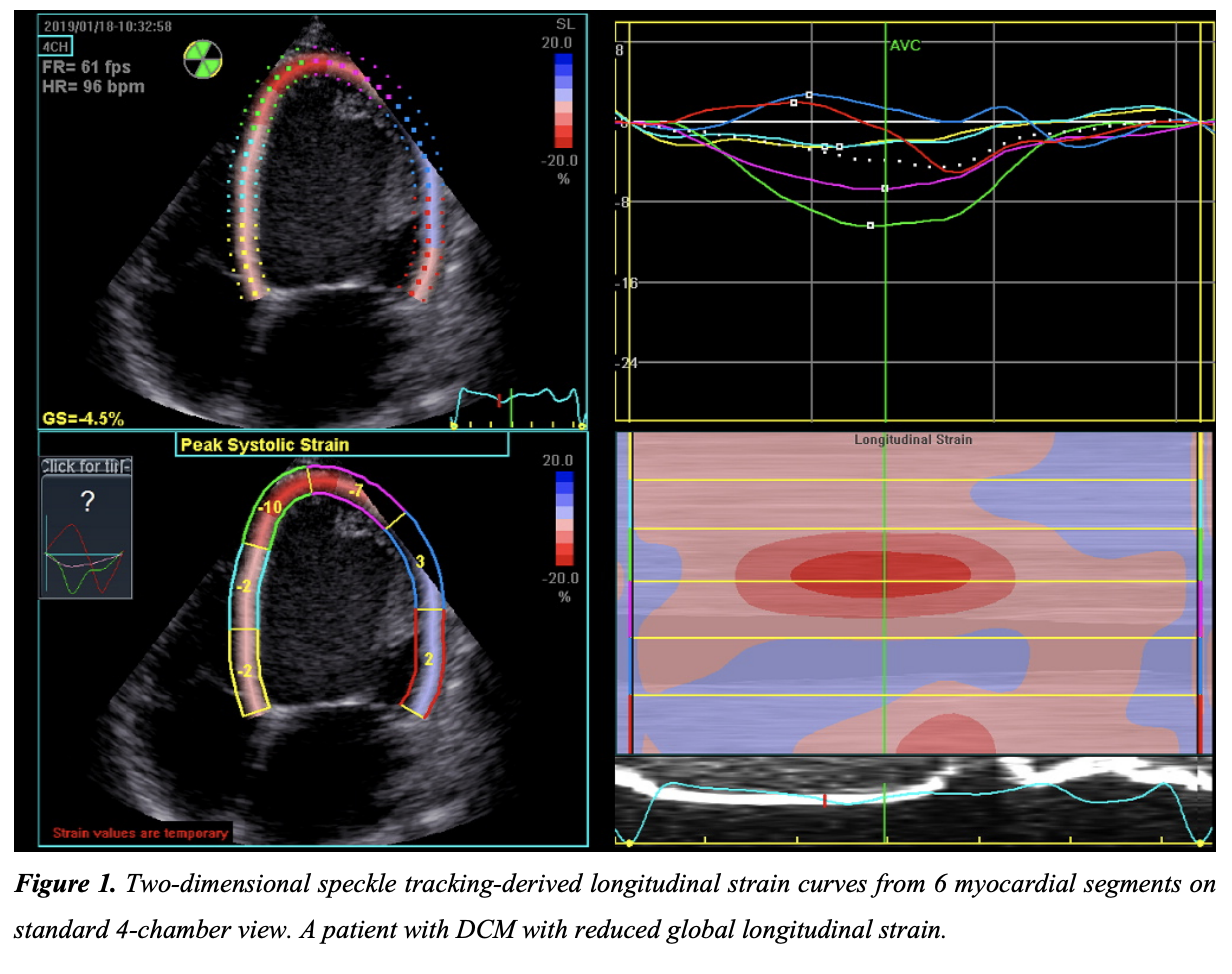
2D TTE showed significantly impaired
left ventricular ejection fraction (LVEF 20%, GLS
-5%) (Fig. 1 -2) , dilated left ventricle (LVEDDi
31,8 mm/m
2
, LVEDV 245 ml, LVESV 210 ml),
LV was globally akinetic, trabeculated, spherical
shaped, in the apex four thrombus was noticed (the
largest 36x14mm) (3 pav.) , dilated mitral anulus,
moderate (II-III*) MV insufficiency, RV function
was impaired (FAC -22.7%). Chest x-ray showed
pneumonia in the right lung.
Journal of Medical Sciences. May 25, 2020 - Volume 8 | Issue 17. Electronic-ISSN: 2345-0592
71
In the course of adequate heart failure,
pneumonia treatment, anticoagulation therapy
patient’s status got worsening, negative clinical
signs showed up such as new onset pain in the
chest with elevated cardiac enzymes (TnI 11 μg/l),
abdominal pain, numbness in both foots and right
foot skin discoloration, so for a detailed work up
chest-abdomen-pelvis CT was performed and
thrombosis of a. mesenterica, a. lienalis, a. poplitea
was diagnosed.
Surgical trombectomia of a. poplitea, a.
mesenterica superior and inferior was performed.
Coronary angiography was with no lesions. Cardiac
MRI confirmed dilated cardiomyopathy with
preserved LV and RV function, suspicion of edema
in LV anterior and lateral walls, ischaemia induced
fibrotic areas in LV mid-inferior, posterior and
apical inferior segments.
Despite adequate antibacterial treatment
and reduction of inflammatory markers clinical
signs of infection remained - nasopharyngeal
specimen confirmed Influenza A virus. In suspicion
of viral induced myocarditis endomyocardial
biopsy was performed and histological study ruled
out myocarditis diagnosis.
After 10 months of guideline-directed
medical HF treatment, cardiac MRI showed
marginally improved LVEF (38%) and RV FAC (-
38.6%), dilatation of left cardiac chambers remains
the same. Subendocardial late gadolinium
enhancement remains in left inferior and apical
segments.
Figure 1. Two-dimensional speckle tracking-derived longitudinal strain curves from 6 myocardial segments on
standard 4-chamber view. A patient with DCM with reduced global longitudinal strain.
Journal of Medical Sciences. May 25, 2020 - Volume 8 | Issue 17. Electronic-ISSN: 2345-0592
72
Figure 2. Two-dimensional speckle tracking echocardiography showing reduced global longitudinal strain.
Figure 3. Transthoracic echocardiography. Thrombus in left ventricular apex.
Journal of Medical Sciences. May 25, 2020 - Volume 8 | Issue 17. Electronic-ISSN: 2345-0592
73
4. Discussion
DCM is more common in men than in
women (14). A large proportion of patients with
DCM do not experience any symptoms and have a
long latency period. Our patient did not have
classic symptoms and signs of DCM such as
fatigue, edema in legs, ankles or feet and heart
murmurs. The main symptoms of our patient were
fever, cough, frequent cardiac activity and
weakness. DCM was found accidentally by TTE.
And the main question was - what was the cause of
DCM in young, previously healthy individual? For
this reason, every patient with suspected DCM
should be evaluated by TTE or MRI.
The most common etiology of DCM is
idiopathic and without an identifiable cause (14).
The secondary causes include infectious
myocarditis, ischemic disease, hypertension,
medication-induced, alcohol abuse, human
immunodeficiency virus, peripartum
cardiomyopathy, or infiltrative disease (14). It was
difficult for our patient to differentiate the main
cause - DCM induced influenza virus was first
suspected. Infections are believed to account for
~30% of the etiology of DCM and are typically
associated with myocarditis, as it has been
demonstrated in animal models and human patients
(4). One of the most common groups of viruses
associated with DCM are the enteroviruses,
adenoviruses and herpesviruses (12). The positive
identification of viral genome with biopsy is
associated with a more-rapid progression to DCM
and worse clinical outcomes
(13). Our patient was
diagnosed with influenza A virus. A biopsy was
performed to differentiate etiology of this disease.
However, histological examination ruled out the
diagnosis of myocarditis, so we began to search for
another cause of DCM.
Taking into account patients’ previous
history, the most reasonable cause of cardiac
damage was synthetic testosterone. Anabolic-
androgenic steroid (AAS) is the synthetic
derivative of the male hormone testosterone that is
often used by athletes to increase muscle mass (10).
This can produce side effects such as
gynaecomastia, testicular atrophy, liver adenomas
and severe cardiac effects. Steroids are thought to
cause changes in heart muscle structure through
their effect on androgen receptors expressed on
cardiac myocytes (11). In men without any risk
factors, long‐term testosterone use may lead to
cardiac death, myocardial infarction, hypertension,
cardiomyopathy including ventricular hypertrophy
and dilatation and HF. Other cardiotoxic events are
changes in lipid metabolism, hypercoagulable
states and polycythaemia. AAS can directly harm
the myocardium by causing tissue fibrosis and
apoptosis.
5. Conclusions
1) Anabolic steroids use is a rare, reversible
cause of cardiomyopathy in young,
otherwise healthy athletes. Therefore, it is
very important to know patients
anamnestic data well. In this case, patient
admitted the use of injections of synthetic
testosterone.
2) Discontinuation of testosterone use and
the initiation of guideline-directed medical
treatment are advocated and, as
demonstrated in our case, may improve
cardiac function.
3) It is important to prevent complications
that DCM can cause, such as: circulatory
collapse, arrhythmias, and
thromboembolic events.
Journal of Medical Sciences. May 25, 2020 - Volume 8 | Issue 17. Electronic-ISSN: 2345-0592
74
6. References
1. Al-u’datt D, Allen BG, Nattel S. Role of the
lysyl oxidase enzyme family in cardiac function
and disease. Cardiovasc Res [Internet]. 2019
[cited 2020 May 15];115(13):182037.
Available from:
https://academic.oup.com/cardiovascres/article/
115/13/1820/5550702
2. Oliver J Müller, Markus B Heckmann, Lin
Ding, Kleopatra Rapti, Ashraf Y Rangrez,
Thomas Gerken, Nicole Christiansen, Ulrike E
E Rennefahrt, Henning Witt, Sandra González
Maldonado, Philipp Ternes, Dominic M
Schwab, Theresa Ruf, Susanne Hille, Anca
Remes, Andreas Jungmann, Tanja M Weis,
Julia S Kreußer, Hermann-Josef Gröne,
Johannes Backs, Philipp Schatz, Hugo A Katus,
Norbert Frey, Comprehensive plasma and tissue
profiling reveals systemic metabolic alterations
in cardiac hypertrophy and
failure, Cardiovascular Research, Volume 115,
Issue 8, 1 July 2019, Pages 1296
1305, https://doi.org/10.1093/cvr/cvy274
3. Mark Nicholls, Men, testosterone, and
arteriosclerosis, European Heart Journal,
Volume 37, Issue 46, 7 December 2016, Page
3430, https://doi.org/10.1093/eurheartj/ehw492
4. Schultheiss H-P, Fairweather D, Caforio ALP,
Escher F, Hershberger RE, Lipshultz SE, et al.
Dilated cardiomyopathy. Nat Rev Dis Primers
[Internet]. 2019;5(1):32. Available from:
http://dx.doi.org/10.1038/s41572-019-0084-1
5. Weintraub RG, Semsarian C, Macdonald P.
Dilated cardiomyopathy. Lancet [Internet].
2017;390(10092):40014. Available from:
http://dx.doi.org/10.1016/S0140-
6736(16)31713-5
6. Japp AG, Gulati A, Cook SA, Cowie MR,
Prasad SK. The diagnosis and evaluation of
dilated cardiomyopathy. J Am Coll Cardiol
[Internet]. 2016;67(25):29963010. Available
from:
http://dx.doi.org/10.1016/j.jacc.2016.03.590
7. De Paris V, Biondi F, Stolfo D, Merlo M,
Sinagra G. Pathophysiology. In: Sinagra G,
Merlo M, Pinamonti B, editors. Dilated
Cardiomyopathy: From Genetics to Clinical
Management [Internet]. London, England:
Springer; 2019. Available from:
http://dx.doi.org/10.1007/978-3-030-13864-6
8. Merlo M, Cannatà A, Gobbo M, Stolfo D,
Elliott PM, Sinagra G. Evolving concepts in
dilated cardiomyopathy. Eur J Heart Fail
[Internet]. 2018;20(2):22839. Available from:
http://dx.doi.org/10.1002/ejhf.1103
9. Bakalakos A, Ritsatos K, Anastasakis A.
Current perspectives on the diagnosis and
management of dilated cardiomyopathy Beyond
heart failure: a Cardiomyopathy Clinic Doctor’s
point of view. Hellenic J Cardiol [Internet].
2018;59(5):25461. Available from:
http://dx.doi.org/10.1016/j.hjc.2018.05.008
10. Hartgens F, Kuipers H. Effects of androgenic-
anabolic steroids in athletes. Sports Med
[Internet]. 2004;34(8):51354. Available from:
http://dx.doi.org/10.2165/00007256-
200434080-00003
11. Davey RA, Grossmann M. Androgen receptor
structure, function and biology: From bench to
bedside. Clin Biochem Rev [Internet].
2016;37(1):315. Available from:
https://www.ncbi.nlm.nih.gov/pubmed/2705707
4
12. Cabrerizo M, et al. Molecular epidemiology of
enterovirus and parechovirus infections
according to patient age over a 4-year period in
Spain. J. Med. Virol. 2016;89:435442. doi:
10.1002/jmv.24658.
Journal of Medical Sciences. May 25, 2020 - Volume 8 | Issue 17. Electronic-ISSN: 2345-0592
75
13. Caforio ALP, et al. A prospective study of
biopsy-proven myocarditis: prognostic
relevance of clinical and aetiopathogenetic
features at diagnosis. Eur. Heart
J. 2007;28:13261333. doi:
10.1093/eurheartj/ehm076
14. Mahmaljy H, Yelamanchili VS, Singhal M.
Dilated Cardiomyopathy. In: StatPearls
[Internet]. Treasure Island (FL): StatPearls
Publishing; 2020. Available from:
https://www.ncbi.nlm.nih.gov/pubmed/2872294
0